What "Just Because!" Revealed About "Somehow" — The Restlessness of Exam Season and the Distance of Chasing Someone's Back
tarumaki
Enter the Moment
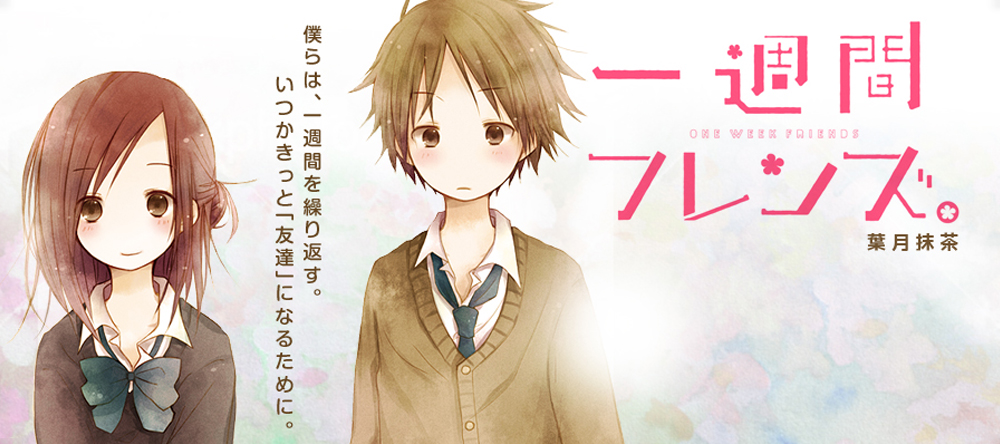
Based on the manga by Matcha Hazuki, “One Week Friends” (Isshuukan Friends) is a coming-of-age story that was adapted into a TV anime in 2014 and a live-action film in 2017, becoming a masterpiece engraved in the hearts of many fans.
The story depicts the heartbreaking yet warm daily lives of Kaori, who tries to hold onto memories that disappear after one week through her diary; Yuki, who struggles to protect her smile; and the friends who watch over them. The greatest appeal of this work is its pure portrayal of youth, wrapping the painful setting of “memory loss” in pale, gentle colors and delicate psychological descriptions.
Yuki Hase, a second-year high school student, decides he wants to become friends with his classmate, Kaori Fujimiya, who always stays alone and avoids interacting with others. He gathers the courage to speak to her. However, she refuses him, saying, “My memories of my friends… disappear in one week.”
A girl who continues to lose memories of the boy. A boy who weaves those memories together, one by one. A gem of a story filled with “heartbreak” and “devotion.”
This youth graffiti comic by Matcha Hazuki (published in Square Enix’s Monthly Gangan JOKER) is adapted into a TV anime. Kaori, whose memories of friends vanish in a week, and Yuki, who devotedly tries to become her friend despite this. The subtleties of the hearts of these two protagonists are depicted with delicate and beautiful animation by Brain’s Base, the studio known for Natsume’s Book of Friends.
For the cast, fresh talents were selected to breathe life into the protagonists: Yoshitaka Yamaya, who sincerely plays the straightforward Yuki, and Sora Amamiya, a promising newcomer (at the time) who expresses Kaori’s complex emotions.
“Please, become friends with me.”
Just a single phrase. Yet, I know of no other words so heavy and beautiful. The anime One Week Friends (Isshuukan Friends.), broadcast in 2014. Based on the manga by Matcha Hazuki, this work is a record of an overly honest and poignant youth between Kaori Fujimiya, a girl who loses her memories of friends in a week, and Yuki Hase, a boy who tries to become her friend regardless.
Painted in pale, beautiful colors like pastel art, this work may look like a fluffy slice-of-life romantic comedy at first glance. However, flowing deep within it are universal and philosophical questions: “What is memory?” and “What are feelings?”
The despair of seeing built-up relationships crumble every time Monday comes and memories are reset. Still, the strength of the protagonist who continues to say, “Please become friends with me.” Today, from the perspective of a veteran columnist, I will dig deep into the shock of the first episode that cannot be told without tears, the charming characters that color the story, and the form of “pure love” depicted in this work. My rating is, of course, a doubtless 5 stars.
Let me assert this first: Episode 1 of this work is a “God Episode” remaining in anime history. It is rare to find a work with such a perfect narrative structure (Introduction, Development, Twist, Conclusion) packed into just 30 minutes.
The protagonist, Yuki Hase, becomes interested in Kaori Fujimiya, who is isolated in class, and summons the courage to speak to her. However, she confesses the shocking fact that “memories of friends disappear in a week” and rejects him. Still, touched by Hase-kun’s kindness in not giving up, Fujimiya-san gradually opens her heart. Lunch on the roof, casual conversations, her first smile. Just as viewers felt relieved thinking, “Good, this is going to work out,” the destined Monday arrives.
“…Um, who are you?”
The moment this cold reality was thrust upon us, many viewers must have felt their chests tighten. However, the action Hase-kun took here, and that “one phrase” he uttered, are the essence of this story and the trigger that bursts the viewers’ tear ducts. The catharsis when Sukima Switch’s masterpiece “Kanade,” covered by Sora Amamiya, overlaps there is… Just watching this first episode is enough to say there is value in touching this work.
In some reviews, there seem to be critical voices calling the protagonist Hase-kun a “wimp” or “persistent.” However, I evaluate him as a “super cool guy.”
His motivation might have initially been a simple ulterior motive typical of a high school boy: “I want to get along with that cute girl.” He gets jealous and shows possessiveness. He is truly life-sized. However, even after knowing Fujimiya-san’s cruel fate, he did not run away. Every time Monday comes, “Hase-kun” inside her disappears, and he returns to being just a classmate. The sense of futility and fear that the built-up relationship becomes zero must be immeasurable. Not knowing how long it will last. No guarantee of becoming lovers. Still, every week, he continues to say with a trembling voice, “Please, become friends with me.”
This honesty is his “manliness” (Otokogi). Only his clumsy and straightforward feelings, not relying on techniques, continue to knock on the door of Fujimiya-san’s closed heart, little by little but surely. I feel that his attitude teaches us, who tend to seek only efficiency and results in modern times, the origin of “caring for people.”
The word that symbolizes the worldview of One Week Friends is “Paleness.” Gentle animation like pastel drawings, depictions of daily life excluding excessive drama, and the slowly progressing relationship between the two. It is too pure to be called a “Romantic Comedy” and too warm to be called “Serious.”
Supporting this gentle world are the charming supporting characters. Hase-kun’s best friend, Shogo Kiryu. Although he looks cool and indifferent at first glance, he thinks about the two more than anyone else and is the best nice guy who gives precise advice and follow-up. And the natural-airheaded mysterious girl, Saki Yamagishi. With her appearance, the story gains brightness, and Fujimiya-san’s world expands from just Hase-kun to a “circle of friends.”
All the characters are somewhat clumsy but fundamentally “good people.” There are no mean rivals or muddy developments (there is a little disturbance in the final stages, but that is also due to the conflict typical of boys). The scene where Fujimiya-san re-reads her diary and feels “it was fun” even without the realization of memory, and the happy smile she showed at karaoke. Those are miracles born from the accumulation of kindness from people around her, including Hase-kun.
One Week Friends has no flashy magic or action, but it is a masterpiece that carefully depicts the subtleties of the human heart.
Fujimiya-san fighting the fear of losing memories, and Hase-kun trying to accept her along with that fear. Their love (or friendship) seems to be reset every week, but in fact, it might be accumulating little by little in an invisible place. The lingering feeling of the final episode is also wonderful, giving us hope that “the day when memories stick might come someday.”
If you are tired of daily human relationships and feel your heart is a little rough, please watch this work. When you touch Hase-kun’s words “Please become friends with me” and Fujimiya-san’s tears, surely a warm and gentle “pale color” will light up in your heart too.
And after watching, you will want to say “Thank you” to your precious friends and partners again. Because even if memories disappear, feelings do not.
© 葉月抹茶/スクウェアエニックス・「一週間フレンズ」製作委員会