What "SukaSuka" Asks: The Definition of the Happiest Girl in the World — A Record of Ephemeral Yet Beautiful Love Blooming in a Dying World
tarumaki
Enter the Moment
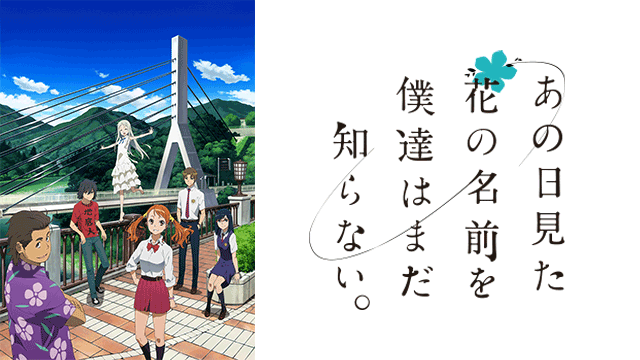
“Anohana: The Flower We Saw That Day” (abbreviated as “Anohana”) is an original anime series broadcast in 2011, produced by A-1 Pictures with a script by Mari Okada. Themed around the “reunion of childhood friends” and “a miracle of one summer,” this heartbreakingly beautiful coming-of-age ensemble drama evoked deep emotions and became a massive hit.
The appeal of this series lies in its deep exploration of the delicate and complex emotions unique to adolescence, such as friendship, romantic attraction, and regret. The visuals beautifully depicting the summer landscapes, the heart-touching music, and the collision of the characters’ sorrowful emotions invite viewers’ tears.
They used to be close childhood friends. However, now that they are high school students, they have drifted apart before they knew it.
The protagonist “Jintan,” who has become somewhat of a shut-in. “Anaru,” who tends to just go along with her gal friends. “Yukiatsu” and “Tsuruko,” who attend an elite academic school. “Poppo,” who chose not to go to high school and travels instead. And “Menma,” the girl who hasn’t changed since they were close elementary school students, while everyone else has changed.
One day, Menma asks Jintan, “I want you to grant my wish.” Though perplexed, Jintan tries to figure out what “Menma’s wish” could be. Triggered by Menma’s wish, the childhood friends, who were living their own lives in their own separate worlds, begin to gather once again just like in the past.
“We used to be so close, so why did things turn out this way?” As we grow into adults, don’t we all sometimes harbor such bittersweet thoughts?
The usual place, the usual friends, summer vacations we believed would never end. But as time passes, people change. Environments change, words change. We become too embarrassed to even call each other by the nicknames we used to use. We occasionally feel loneliness in the “distance of the heart” born that way.
The masterpiece I am introducing today depicts such universal pain and rebirth: Anohana: The Flower We Saw That Day (often called “Anohana”).
More than 10 years have passed since its broadcast in 2011, but when summer comes, I still want to watch it again. Fans continue to visit the sacred sites in Chichibu. Why does this work grab our hearts so strongly and refuse to let go? From the perspective of a veteran columnist, I will unravel the true charm of this work, which cannot be fully described by the label of “an anime that makes you cry.”
Are your handkerchiefs ready? No, a bath towel might be better.
The story begins when the shut-in protagonist, Jinta Yadomi (Jintan), is visited by Meiko Honma (Menma), a girl who was supposed to have died in an accident when they were young. Moreover, although she is a ghost, she appears not as a child from back then, but grown up just like Jintan and the others.
This “what if” setting is brilliant. The members of the “Super Peace Busters,” a group of close friends who used to gather at a secret base, had become high school students and were walking completely different paths. An elite attending a prep school, a girl who became a gal, a wanderer traveling the world. Their appearances and personalities had changed, and they kept their distance from each other while carrying the trauma of Menma’s death. It was none other than the late Menma’s “wish” that brought them back together.
Through their awkward reunion, viewers overlay their own pasts. The embarrassment peculiar to adolescence of calling the nickname “Anaru,” and the sense of inferiority towards friends who have changed. But as the story progresses, we realize: even if their looks and words have changed, their roots haven’t changed at all. Only Menma remains there, innocent as she was back then. That contrast brings their growth and the preciousness of what they have lost into relief, beautifully and cruelly.
Although some voices ridicule this work as “tear-jerker bait” or “emotional porn,” I deny that head-on. Because the essence of this story lies not in “death” itself, but in “how those left behind face their regrets.”
Childhood is not just full of sparkling memories. A careless word said. A moment of not being honest. Pretending not to be interested in someone you actually liked. “Failures” that seem trivial when you become an adult continue to cause pain in the heart like a fish bone stuck in the throat when they are from childhood.
All the characters harbor some kind of “guilt” regarding Menma’s death. “If only I had done that back then.” Such universal regret that everyone harbors at least once. The sight of them clashing, cursing each other, yet facing that pain and putting it into words is painful yet beautiful. Before discussing “production techniques to make you cry,” their conflicts are so human and real that we naturally shed tears.
Especially the background depictions, such as the humid summer heat and the greenery of Chichibu’s mountains and forests, are wonderful. If this had been a story in a big city or by the sea, that level of nostalgia would not have been born. That slightly enclosed landscape of the basin links with their mental scenery.
And it is impossible not to talk about that final episode, which remains in anime history.
The OP song “Circle Game” by Galileo Galilei is wonderful, but the destructive power of the ED song, ZONE’s cover of “secret base ~Kimi ga Kureta Mono~,” is tremendous. The moment the intro of this song flows in sync with the climax of the story, the dam of tear ducts breaks. The lyrics and the story synchronize so perfectly that it seems as if the song was written for this anime.
The “Hide-and-Seek” in the final episode. That was not mere play. It was a ritual for the scattered Super Peace Busters to become one in the true sense. After hurling their feelings at each other and exposing their jealousy and regrets, everyone shouts, “Menma, found you!” And the reply from Menma.
In that instant, we viewers realize that we, too, had become “members of the Super Peace Busters” in front of the TV. A sense of loss that makes you unable to move for a while after watching. But strangely, the heart feels warm. “I want to see my friends,” “I want to be a little kinder.” It was a last scene that made us realize such ordinary happiness.
Anohana: The Flower We Saw That Day is not just a story that beautifies the past. It is a life-sized youth ensemble drama of young people trying to walk toward the future while embracing the pain of the past.
Even after more than 10 years since the broadcast, the animation hasn’t faded at all; rather, it has a message that resonates even more in this era. If you haven’t seen this work yet, please give it a try. And if you have seen it before, please watch it again this summer.
Surely, emotions different from back then should sprout. And if the face of an old friend suddenly comes to mind, why not try contacting them? Just a simple “How are you?” is enough. Just that might bring you back to who you were back then.
Menma is no longer here, but the kindness she taught us continues to bloom in our hearts forever.
© ANOHANA PROJECT