"TARI TARI" Teaches Us the Preciousness of Detours — The Score of Youth Echoing in Enoshima with "Chorus, Sometimes Badminton"
tarumaki
Enter the Moment
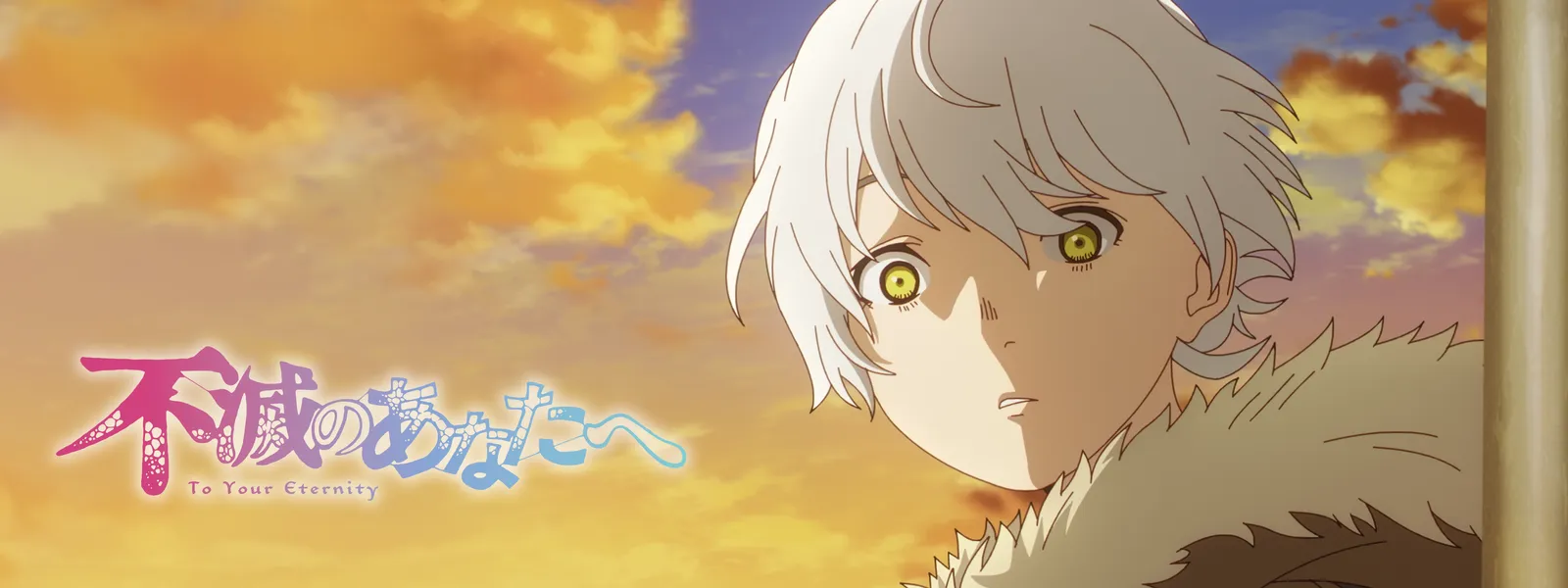
About the Work Based on the manga by Yoshitoki Oima, “To Your Eternity” is a grand and moving fantasy masterpiece adapted into an anime in 2021, themed around life, death, and growth. The protagonist is an “Orb” named “Fushi.” He is an immortal being possessing “the ability to gather information” and “the ability to transform into the forms of things that stimulate him.” Fushi begins his wandering journey through the world, changing his form from a stone to moss, then to a boy living in the polar regions, and eventually to a wolf.
The appeal of this series lies in its deep—and at times cruel—depiction of the sanctity of life and the beauty of the human heart. Through Fushi’s perspective, viewers are confronted with universal questions: “What does it mean to live?” and “What does it mean to connect with others?”
Fushi, an immortal existence. Opposing him are the “Nokkers,” a hostile force seeking to attack and destroy humanity. After a fierce defensive battle, Fushi emerged victorious against the Nokkers, but he still needed to continue protecting the people. He expanded his own body, spreading roots of resistance like a tree.
Hundreds of years later, the setting shifts to the modern world. A world more peaceful than ever before. New friends… a new home… Fushi thought he could finally enjoy happiness in a world filled with everything he desired. However, an unsettling shadow approaches Fushi once again. It is his archenemy, creeping into the crevices of the human heart.
To Your Eternity (Fumetsu no Anata e). having finished this series, I am left with a heavy emotion that is hard to put into words, juxtaposed with a warm, lingering light in my chest.
To be honest, it has been a long time since an anime has stimulated my tear ducts and shaken my heart to this extent. The protagonist, “Fushi,” began as nothing more than an “orb.” Knowing no people, no world, and not even pain, he gradually forms the contours of a “human” through encounters and partings with people like March, Parona, Pioran, Gugu, and Tonari. Watching his process of growth was a deeply ambivalent experience; I was torn between a desire to see what happens next and a refusal to witness any more heartbreaking scenes.
However, that is precisely why this work is worth watching. From the perspective of a veteran columnist, I would like to unravel the “weight of life” and the “abyss of the narrative” depicted in this masterpiece.
The greatest appeal of this story—and simultaneously the harshest trial for the viewer—is how it depicts “partings.”
From the gripping first episode, the show’s ruthlessness was on full display. Watching the boy, who was betrayed at the very end of the path he believed in, yet still tried to look forward as he tragically died, was, to put it bluntly, excruciating. Then came the death of March, who taught Fushi the emotions of a “mother,” the importance of saving others, and awakened his feelings. The moment her innocent wish was cut short, our emotions were violently shaken.
Personally, the Takunaha Arc remains the most memorable. Gugu, who grew up like a brother to Fushi and protected his beloved Rean even after his body was forced to wear a mask. The development where he loses his life to a Nokker attack, just as he finds relief in conveying to Rean that he was the boy who saved her back then… It was painful enough to make me look up to the heavens and wonder how much the creators wanted to drive the viewers to despair. Yet, this anime had the power to make me think, “I want to see his life through to the end,” despite the pain.
However, not all partings were despair. The parting with Pioran was distinct from the deaths that came before. She was the person who had been with Fushi the longest and accepted him in his imperfect state. Her death was a result of the “inevitable passage of time” for a human. She was satisfied with her life, and Fushi’s “Thank you” to her was not a word mixed with repentance, but a pure, white expression of gratitude. The feeling of “I was happy” that Fushi attained felt like a hymn to humanity itself, encompassing all the joys of meeting and the sorrows of parting.
What sets this work apart from other fantasy series is the unique standing of the protagonist, Fushi.
An “orb” thrown in by the “Beholder” (voiced by Kenjiro Tsuda). Its only rule is to “change upon receiving stimulation.” While Fushi is the protagonist, he rarely initiates heroic moves to drive the story forward himself. Rather, the unique characters surrounding him advance the plot, and Fushi exists as a catalyst for them. To use an analogy, it feels like a nature science program where a fixed-point camera is placed in a forest to record the ecology of a rare animal over months—it possesses that kind of objectivity and grandeur.
Reiji Kawashima, who plays Fushi, delivered a magnificent performance. Although it was his first starring role, it didn’t feel like he grew as a voice actor alongside the character’s updates; rather, he drew us in from the first episode with a performance that perfectly captured an “empty vessel.”
Furthermore, the way the world accepts the setting of “immortality” is very Japanese and intriguing. Normally, one would expect conflicts over obtaining the power of immortality, but the people in this world accept it as just another “characteristic.” Even Hayase did not try to become immortal herself. Unlike Qin Shi Huang seeking eternal power, she treated it as something that simply “exists.” On the other hand, Hayase’s twisted faith—a process where pure awe and devotion curdle into a cult-like obsession—portrayed a terror that boils down human karma, making her a far more suggestive presence than the silent enemy, the “Nokkers.”
I cannot speak of this work without mentioning the original author, Yoshitoki Oima. While retaining the skillful psychological portrayal seen in A Silent Voice (Koe no Katachi), this work brilliantly fuses SF battle elements cultivated in works like Mardock Scramble.
The quality of the battle scenes and nature depictions is particularly overwhelming. The scene where Fushi transforms into a wolf, the quivering of his fur, the motion of cutting a rope with a knife, and the raw fighting instinct shown when fighting a bear while regenerating—these movements are full of life, reminiscent of Studio Ghibli works, especially Princess Mononoke. Also, the themes flowing at the foundation of the story carry the scent of philosophy and reincarnation found in Osamu Tezuka’s Phoenix (Hi no Tori).
Towards the end of the season, Fushi gained the ability to create gunpowder. Now capable of producing explosives and weapons without volume restrictions, how will he fight in the future? With “cheat” tactics like infinite bombs and infinite machine guns now possible, what awaits him: further isolation or a new form of coexistence?
This work remains realistic throughout, carefully designed so that viewers can find foreshadowing in the depictions to connect the dots regarding their doubts. It conveys that the author has thought through the contradictions and logic of this world more than anyone else.
Fushi has lost Pioran and realized his constitution attracts the Nokkers. It might be a natural progression for him to cut off connections with others and choose solitude. However, if there is a possibility for Pioran to be reborn, perhaps Fushi himself is the reincarnation of something else.
What does it mean to live as a “human”? What does it mean to remain as a “memory”?
While being philosophical, To Your Eternity never forgets the excitement of entertainment. Encounters and partings, life and death, and love. This work, which depicts universal themes so beautifully and cruelly, can undoubtedly be called a monumental achievement in recent anime.
Including the second series in 2022, I intend to watch this grand epic to the end, to see how Fushi—who has become sufficiently human—will learn, what will shake his emotions, and how his story will conclude. I also look forward to seeing the older version of Fushi (he looks so cool it makes my head spin!).