“There's No Freaking Way I'll be Your Lover! Unless...” — A Sharp, Funny, and Honest Take on Friendship, Love, and Self-Acceptance
tarumaki
Enter the Moment
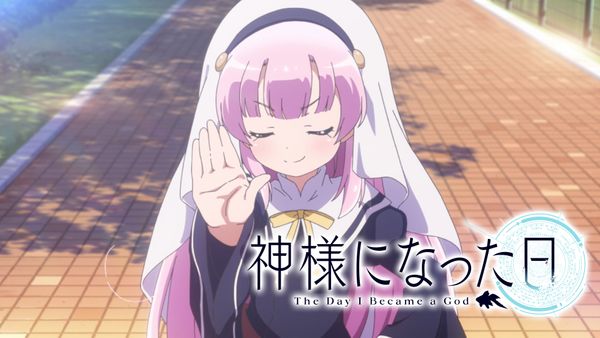
This series depicts the unforgettable summer vacation of Yota and his friends, who are dragged around by Hina, a girl who claims to be a god, and her prophecy that “the world will end in 30 days.”
The greatest appeal lies in the vivid contrast between their comical, dazzling daily lives and the cruel truth thrust upon them in the second half. The lyrical camerawork and meticulous screen composition characteristic of P.A.WORKS clearly reflect the fragility of a girl living on borrowed time and the earnest emotions of a boy sprinting forward believing in miracles, fiercely striking the viewer’s heart.
Yota Narukami, a third-year high school student, is taking a break from studying for his college entrance exams by playing basketball in a park when he meets Hina, a girl wearing a nun’s habit.
Hina proudly declares to Yota, “I am the omniscient god,” and then tells him, “The world will end in 30 days.” Yota doesn’t believe her at first, but he soon witnesses the “miracles” Hina brings about one after another.
“The world will end in 30 days.” One day, a girl in a nun’s habit named Hina Sato, who claims to be the omniscient god Odin, suddenly appears and tells the protagonist, Yota Narukami, exactly that. Following Angel Beats! and Charlotte, The Day I Became a God is the third original anime series written entirely by Jun Maeda (Key). With overwhelming anticipation before its broadcast and the tagline “A return to the origins of the crying game (Nakige),” many anime fans were thrilled.
However, after the 12-episode broadcast concluded, a fierce storm of mixed reviews blew across the internet. While there are negative opinions saying, “It was a letdown” or “The developments in the final stages are too tough,” there are also passionate voices of support saying, “It’s my favorite among Maeda’s works” or “It made me think deeply.” Why did this work divide opinions so sharply?
Today, from the perspective of a veteran columnist, I would like to dig deep into the “cruel reality” encapsulated in The Day I Became a God, and the clinging to “living” that flows at its depths. To conclude first, this might not be a work that is unconditionally praised as a “God-tier Anime” (Kami Anime). However, it is undoubtedly a “good work that leaves a powerful, unforgettable thorn.”
In the first half of the story, a slapstick and comical daily life is depicted, using Hina’s “omniscient power” to support Yota’s love for his childhood friend or to rebuild a rundown ramen shop. Perfectly predicting the pitch types in baseball, or winning with a Yakuman (highest-scoring hand) in Mahjong without even knowing the rules (Episode 4’s Mahjong episode is polarizing, but personally, I laughed my head off). Thanks to the beautiful and overwhelming animation of light by P.A.WORKS and the well-paced banter of talented voice actors like Natsuki Hanae and Ayane Sakura, viewers can genuinely enjoy a “slightly mysterious, fun, summer youth story.”
However, this countdown of “X days until the end of the world” and the setting of an omniscient, omnipotent god were the greatest misleads. Viewers expect mysteries of the afterlife like in Angel Beats! or fierce battles between espers like in Charlotte. However, Hina’s “secret” revealed in the middle stages was much more realistic and cruel.
A quantum computer was implanted in Hina’s brain, which gave her her omniscient powers. She herself suffers from a congenital, intractable disease called “Logos Syndrome,” and if the computer is removed, she will revert to a state where she can neither walk nor speak. “The world ending” did not mean the destruction of the Earth, but rather the end of Hina’s own “perceived world (consciousness).”
This “downscaling” was the first point that divided opinions on this work. For the demographic expecting a grand sci-fi fantasy, it is understandable that they felt let down. However, by shifting the story’s focus from “the world” to “the life of one girl,” the true theme of this work is brought into sharp relief.
The final stages unfold after Hina is taken away by an organization and the computer in her brain is extracted. From here, the story casts aside its bright atmosphere and plunges straight into a heavy, painful reality.
The reunited Hina has no trace of the energetic “God” she once was; she has lost her words and become a “patient” who only sits in a wheelchair. She doesn’t recognize Yota and just cowers and rejects him. What is depicted here is “bare life” itself, stripped of the convenient filters of “personality” or “memories.” If this were a past Maeda work, a development where a miracle occurs and the disease is cured, or perhaps a beautiful parting (death), might have been prepared here. But The Day I Became a God rejected that.
Hina’s disease is not cured. She will live the rest of her life requiring nursing care. Yota accepts her, saying “That’s fine,” and resolves to live together with her. Some viewers criticized this, saying, “Yota’s actions look like self-satisfaction” or “The development where Hina suddenly likes Yota is unnatural.” Indeed, it is difficult to fully depict that emotional transition within a 1-cour runtime, and it cannot be denied that there were points of insufficient explanation (or relying too much on explanatory dialogue).
However, Ayane Sakura’s overly realistic acting stripped of emotion (that “sober tone” gave me goosebumps) and Yota’s unrefined determination to confront the cruel reality thrust the heavy themes of “nursing care” and “disability” upon us, transcending the framework of anime fiction.
“Living desperately in this unreasonable world.” This is Jun Maeda’s hymn to life, consistently depicted since his early works like Kanon and AIR. This work can be said to be the one that tried to depict that theme in its most cruel, yet most sincere form.
No miracles occur. Magical powers are lost. Even so, they support each other and live the remaining imperfect daily life. In the final episode, the sight of them laughing while watching the completed independent film might be too painful to call a happy ending. However, there were undoubtedly “treasure-like days” there that only those who have crawled up from the abyss of despair know. The destructive power when the music and visuals sync up, such as the insert song “The Day It Became a Treasure” (Takarimono ni Natta Hi) or the timing of the ED song playing, is a testament to the awesomeness unique to Maeda’s works.
If you felt “irritated” or “pained” watching this work, it is probably because you have a gentle wish inside you saying, “I want them to be saved, even if only in fiction.” Or perhaps it is an unconscious defense mechanism wanting to look away from the cruelty of reality. This work thrusts a sharp dagger at the viewer, as if accusing the “idealism” lurking in our hearts.
The Day I Became a God is a work that betrays the viewer’s expectations and destroys pre-established harmony. Therefore, it might not be recommended for those seeking a catharsis where everything is neatly resolved. However, if you are looking for a work that depicts “human weakness and strength that isn’t just pretty words,” there is no other anime that pierces the heart like this one.
Even if you felt “it wasn’t for me” on your first viewing, please try rewatching it not as “Yota’s story,” but as “Hina’s story.” Why was she so noisy, enjoying her daily life with Yota and the others as if in a hurry to live? When you realize the tragic determination behind it and the meaning of the “life as a normal girl” she truly desired. Your evaluation of this work in your heart will surely change drastically.
A cruel yet beloved 30-day miracle given by a God. Please witness its conclusion with your own eyes.
(C)VISUAL ARTS / Key / 「神様になった日」Project