“I Couldn’t Become a Hero So I Reluctantly Decided to Get a Job” — A Fantasy Tale That Teaches the Real Meaning of Work
tarumaki
Enter the Moment
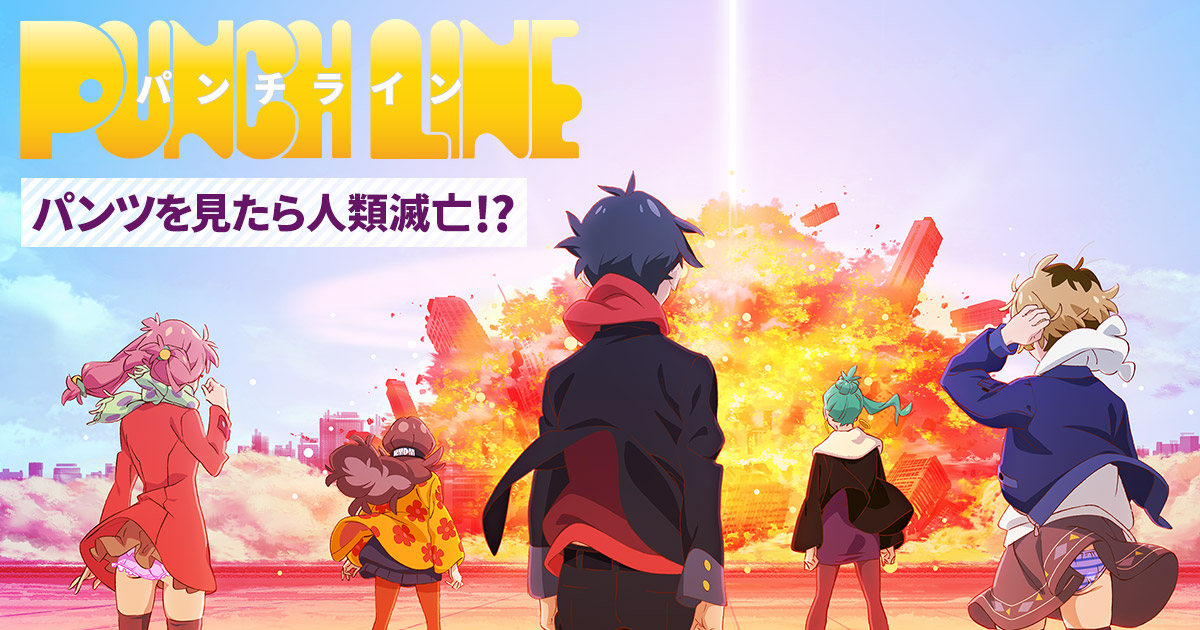
“Punch Line” is an original anime broadcast in 2015 during Fuji TV’s “Noitamina” block. The script was written by Kotaro Uchikoshi (known for the Science Adventure series like STEINS;GATE and Zero Escape), with music by Tetsuya Komuro, and animation produced by MAPPA.
The greatest appeal of this series is its perfection as a dense, profound Sci-Fi time-loop narrative disguised as a “risqué comedy” (ecchi comedy).
“If I see panties, humanity will be destroyed!?”
High school student Yuta Iridatsu becomes separated from his body (astral projection) following a certain incident. Waking up in the apartment where he lives, the “Korai House,” Yuta is told by a cat spirit named Chiranosuke who suddenly appears: “If you want to get your body back, you must find the sacred text hidden somewhere in the Korai House~.”
Thus, Yuta begins his search within the building. However, the moment he catches a glimpse of the panties of the female residents… a terrible catastrophe befalls the Earth…!!! Using his special spiritual powers, Yuta interferes in the lives of the residents. While unraveling hidden mysteries, he steps up to face the fate of humanity’s destruction. Will they be able to reach a supremely happy and peaceful future?
Let me confess honestly. The moment I saw the title, and the moment I watched the opening of the first episode, I harbored the same impression that many viewers likely did: “Ah, here begins another shallow, nonsense gag anime full of lucky lecher moments.” Punch Line. While the word literally means the “outcome” or “climax” of a joke, the sound inevitably evokes “Panchira” (panty shots). The catchphrase is “If he sees panties, humanity will be destroyed!?” At this point, hard-core sci-fi fans and those seeking deep human drama might have quietly removed this work from their watch lists.
However, as a veteran columnist, let me assert: that judgment is far too premature, and I must say you are losing out on an encounter with a “high-quality story” in your life. This original anime, broadcast in Fuji TV’s “Noitamina” block in 2015, uses the extremely low-brow (seemingly) gimmick of panties as an entrance, but in reality, it is a meticulously calculated time-leap sci-fi, a story of familial love, and a solitary heroic tale to save the world.
The script was written by Kotaro Uchikoshi, the creator of the monumental adventure game Ever17 -the out of infinity-. Those who recognize this name will already understand. This work hides a tremendous “mechanism” and “narrative trick.” The catharsis when the numerous settings that seem like mere jokes are recovered as foreshadowing with raging momentum towards the second half is incredible. Today, I would like to unravel the true hidden charms of this eccentric work Punch Line, which has such high information density that it cannot be fully understood in a single viewing, from three perspectives.
The structure of this work is very unique and challenging. It consists of 12 episodes, but up to the first 6 episodes, it unfolds as a slapstick comedy where the protagonist, Yuta Iridatsu, has an out-of-body experience and struggles not to witness the underwear of the residents of the apartment “Korai House.” A bus hijacking incident, a mysterious terrorist organization, Uber-fication (a power-up like Super Saiyan), and repeated destruction of humanity. Viewers will initially be confused, thinking, “What am I watching?” The specialized terms that pop up one after another (VR1, Operation Intercept, AFSpac, etc.) and meaningful items (XXX Maker) fill one’s head with question marks.
However, the story reaches a dramatic turning point (turnover) at Episode 6. It is revealed that the world viewed as a “ghost” until then was actually an information-gathering part of a “failed loop.” The development from here on is the true essence of Uchikoshi’s script. Why did Yuta become a ghost? Why does the earth get destroyed if he sees panties? Who is Chiranosuke? Elements that were scattered in the first half and seemed like mere gags or nonsense settings all fit together like puzzle pieces as “inevitable sci-fi settings” in the second half.
For example, the eccentric naming of the characters. “Yuta Iridatsu (Astral Projection/Yutai Ridatsu),” “Mikatan Narugino (Ally of Justice/Seigi no Mikata),” “Ito Hikiotani (Hikikomori Otaku NEET),” “Meika Daihatsu (Great Inventor/Daihatsumeika),” “Rabura Chichibu (Boobs swinging/Chichi Burabura),” “Kyumei Tsubouchi (Earth Destruction/Chikyu Metsubo).” These are not mere wordplay but function like code names implying the characters’ roles and destinies. Also, the phenomenon “Uber-fication” depicted in the work is logically explained not just as a battle setting but as an important physiological phenomenon related to the root of the story.
What personally impressed me was the precision of the sci-fi settings. Regarding the plot of humanity’s destruction by an asteroid collision, the scientific consideration that ground-based missiles cannot exceed the first cosmic velocity and thus interception is difficult, and the handling of parallel worlds to avoid time paradoxes, show a surprisingly high strength as gadget sci-fi. When realizing that a “resistance against a desperate fate” peculiar to loop stories, similar to Madoka Magica or Steins;Gate, was quietly but hotly progressing under this pop art style, viewers will be unable to take their eyes off the screen.
What is essential in talking about this work is its unique creative texture. The production is by MAPPA, a studio leading the current anime industry. The high quality of the animation is guaranteed, and the delicacy of the characters’ expressions and movements, as well as the intensity of the battle scenes, are simply wonderful. The visual fun is scattered everywhere, such as the retro and warm art setting of the apartment “Korai House” which serves as the stage, the fashion of each heroine, and the depiction of lingerie which is a bit sexy but not too vulgar. The direction of the eyecatches features a stylish design reminiscent of LUPIN the Third: The Woman Called Fujiko Mine, making one feel the sophistication typical of the Noitamina block that is also conscious of the female audience.
And what surprises above all is that the musical score was handled by none other than Tetsuya Komuro (TK). The TK sound that swept the music scene in the 90s fuses with late-night anime of the 2010s. This unique combination gives the work a mysterious nostalgia and elation. Mr. Komuro’s music demonstrates immense effect, especially in the switch from daily comical scenes to serious developments, and in the emotional build-up at the climax. The ending theme “Mitsu Mitsu Mitsu (Honey Honey Honey)” and the insert song “Yakusoku no Kanata (Beyond the Promise)” have catchy melodies that stick in your ears once heard, which can be said to be the work of a hitmaker.
The acting of the voice actors is also noteworthy. Marina Inoue, who plays the protagonist Yuta, delivers exquisite acting that goes back and forth between the boundary of a boy and a girl. And Rie Kugimiya, who plays Meika Daihatsu, one of the heroines, speaks in Osaka dialect. Although she is not supposed to be a native speaker, the natural intonation that makes one feel the character’s background (born in Osaka, raised in Kumamoto?) is the pinnacle of voice acting art. Also, the innocent yet powerful acting of Sora Amamiya, who plays the idol Mikatan speaking in Tsugaru dialect, multiplies the charm of the character many times over.
While there are numerous mystery-solving and sci-fi gimmicks, what this work ultimately tried to depict was a story of universal “love.”
The protagonist Yuta is actually depicted as an extremely complex existence, swapping “body” and “soul,” and jumping from the future to the past. Why does he fight? It is to protect his beloved friends and, by extension, humanity. However, the conclusion he chose for that purpose was far too bittersweet.
In the final episode, all foreshadowing is recovered, and the crisis of humanity’s destruction has passed. A “Happy and Peaceful Future” was supposed to be waiting there. However, as the price for obtaining that future, the existence of one boy is sacrificed. The faint feelings of love for Mikatan, the fun days with the friends at Korai House. Yuta’s choice after protecting them all. “Can the next Yuta try hard again and create a future where he doesn’t die?” “If that happens, will this world line change too?” As some viewer reviews suggest, the last scene leaves a touch of loneliness and, at the same time, a lingering resonance that leaves room for interpretation.
Also, Chiranosuke the cat, who plays an important role in the play. Regarding his true identity and purpose, when watching until the end, a certain conviction and a little sadness well up. He was not just a mascot but supported the very structure of the story as an existence watching over and guiding Yuta.
Starting as a gag anime, going through Sekai-kei suspense, and finally closing the curtain as a heartwarming human drama. Punch Line is a work filled with energy like a stew that transcends such genre boundaries. Looking at panties to save the loved one. Who could have imagined that such pure and poignant feelings were hidden behind that act, which seems ridiculous when put into words?
Punch Line is undoubtedly a work that “chooses its audience.” Some may drop out unable to keep up with the vibe of the early stages, and others may get indigestion from the overwhelming amount of information packed in. However, precisely because of that, there is a “scenery” that only those who complete the run can see.
It is the intellectual excitement when the scattered foreshadowing connects into a single line, and the emotion when witnessing the growth and parting of the characters. If you are still avoiding this work thinking it’s “just a panty-shot anime,” that is a great waste. Please, think of it as being tricked and binge-watch it. After watching, surely you will want to look up at the sky while savoring the meaning of the title. And you will come to love the residents of that apartment dearly.
Now, won’t you go on a journey to a happy and peaceful world with Chiranosuke? However, please be very careful about the stimulation of panties. It would be pointless if humanity were destroyed, after all.
©パンチライン製作委員会