“Horimiya” — A Quiet Story of Imperfect Hearts and the Warmth Hidden Within Ordinary Days
tarumaki
Enter the Moment
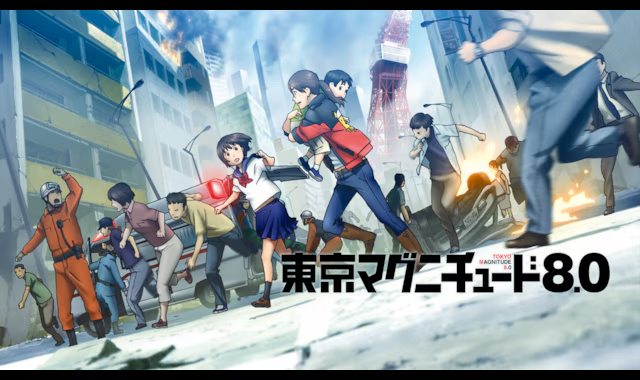
This survival story follows Mirai and Yuki, a sister and brother who encounter a massive M8.0 earthquake in Odaiba, as they try to make their way back home with the help of a woman named Mari, whom they meet by chance.
The greatest appeal lies in the contrast between the unforgiving reality of a collapsed Tokyo and the family bonds that are put to the test under extreme conditions. It is a masterpiece where the shocking, heartbreaking conclusion—and the undeniable personal growth that lies beyond it—will absolutely destroy the viewer’s tear ducts.
Mirai is a first-year middle school student. She is an ordinary girl who feels a vague sense of dissatisfaction with her current life.
Even though it is summer vacation, she has no particular plans, and to make matters worse, her parents force her to take care of her younger brother, Yuki. However, while the two of them are out in Odaiba, the siblings are struck by a massive magnitude 8.0 earthquake!!
“Every day is the same repetitive routine, it’s so boring.” “I wish this world would just break.” Whether during adolescence or even now as an adult, have you ever felt so dissatisfied or bored with your daily life that you thought something like this? However, the peaceful days we call “boring” are actually incredibly fragile, existing on a miraculous balance that we should be profoundly grateful for.
The original anime Tokyo Magnitude 8.0, broadcast on the “Noitamina” block in 2009, mercilessly forces us to confront this cruel truth. Operating on the premise of a massive magnitude 8.0 earthquake striking the Tokyo metropolitan area, this survival human drama depicts the grueling journey of a sister and brother trying to return home to Setagaya from Odaiba.
Despite being produced before the Great East Japan Earthquake of 2011, the disaster depictions—based on extensive research and simulation—are filled with a terrifying level of realism. Today, from the perspective of a veteran columnist, I would like to discuss the profound charm of this work, which transcends the boundaries of a simple “panic anime,” and the “family bonds” embedded within it, focusing on three key points.
At the beginning of the story, a disclaimer appears: “This work is a fiction based on extensive research and verification, assuming a massive earthquake in the Tokyo metropolitan area.” True to these words, the depiction of the disaster in this anime is not half-hearted. Soil liquefaction, buildings collapsing from aftershocks, spreading fires, and streets overflowing with stranded commuters.
Things that were taken for granted are suddenly destroyed; people who were always there are suddenly gone. Even though it is fiction, the immersive quality makes viewers feel, “This could happen to me tomorrow.” Furthermore, what is depicted in these extreme conditions is not just the collapse of buildings, but the wavering of the “human heart.”
Some people panic when cornered, causing confusion by thinking only of themselves. On the other hand, we see the Self-Defense Forces, firefighters, and volunteers who, despite being victims themselves, desperately try to help others. “If I were placed in this situation, could I act like this?” Seeing people silently carrying out rescue operations and guiding evacuations in the anime not only highlights the incredible disaster response of Japan but also strongly questions each viewer about their own mindset and willingness to support others during a crisis.
The core of this story revolves around three characters: 13-year-old Mirai Onozawa, her 8-year-old brother Yuki, and Mari Kusakabe, a single mother who ends up helping them by chance.
When starting the series, many might find the protagonist, Mirai, extremely irritating. Constantly on her phone, rebelling against her family, and constantly complaining—she is the epitome of a “cheeky middle schooler in the midst of puberty.” However, from a parental or adult perspective, that immaturity is exactly what makes her realistic. Thrown into the extraordinary situation of a disaster, Mirai, who initially only complained, gradually grows into her role as a “big sister” and a “human being” to protect her brother. This growth is the greatest pillar of the work.
Additionally, Mari’s presence cannot be overlooked. She left her own young daughter and mother at home, and their safety is unknown—an extreme situation for any mother. Despite surely being out of her mind with worry, she runs herself ragged trying to escort these two children of a stranger home, saying, “This must be fate.” Mari’s deep maternal love and altruism make you want to say, “As long as she is there, everything will be okay.” Through watching Mari’s back, Mirai learns about “adult strength” and “compassion.”
The biggest reason why Tokyo Magnitude 8.0 continues to be highly praised as an “absolute tearjerker” lies in the unbelievably cruel turn of events awaiting in the final stages. During their grueling journey, Yuki—who bravely adored his sister and always stayed positive—suddenly passes away.
Unable to process this traumatic reality, Mirai falls into a dissociative state where she continues walking alongside “Yuki’s phantom (ghost).” Mari, having realized the truth, watches over Mirai with a heavy heart as the young girl talks to a brother who is no longer there. The psychological depiction from Episode 8 onwards is breathtakingly painful and impossible to watch without crying. It is an illusion born of a sister’s defense mechanism fueled by her love for her brother. The words of an elderly volunteer, Mr. Furuichi, flash back: “It should have been me who died.” You never know when someone will pass away. The despair of a life you wanted to protect slipping through your fingers.
However, this work does not end as a mere tragedy. Carrying the heavy cross of Yuki’s death—a burden she will bear for the rest of her life—Mirai finally makes it back to her family and tries to look forward and walk again. “I have to keep walking… Yuki is watching.” The girl who used to do nothing but complain about her daily life has grown by realizing the magnitude of what she lost, biting down on the preciousness of her own life and her family. The use of snapshot photos and music in the ending sequence is unfairly brilliant, leaving a lingering resonance like a deep “prayer” in the viewer’s heart.
While Tokyo Magnitude 8.0 possesses an aspect of disaster preparedness awareness, its foundation depicts universal “family love” and “human growth.”
Over the span of 11 episodes, a girl who thought “I wish this world would break” experiences the kindness of strangers in a broken world, learns the warmth of family, and strongly desires to “live.” It is not a long series, but the density of the message packed within is immeasurable.
If you currently feel that your everyday life is boring. Or if you are finding it hard to be honest with your family. Please, give this anime a watch. After finishing it, you will surely want to open your phone’s contacts, thinking from the bottom of your heart, “I want to see my family,” or “I want to hear the voice of someone precious to me.” And you will realize just how incredibly precious this single, mundane day truly is.
(C)東京マグニチュード 8.0 製作委員会