What "Natsume's Book of Friends" Connects: Spirits (Ayakashi) and Human Hearts — Memories of Kindness, Nostalgic and Bittersweet
tarumaki
Enter the Moment
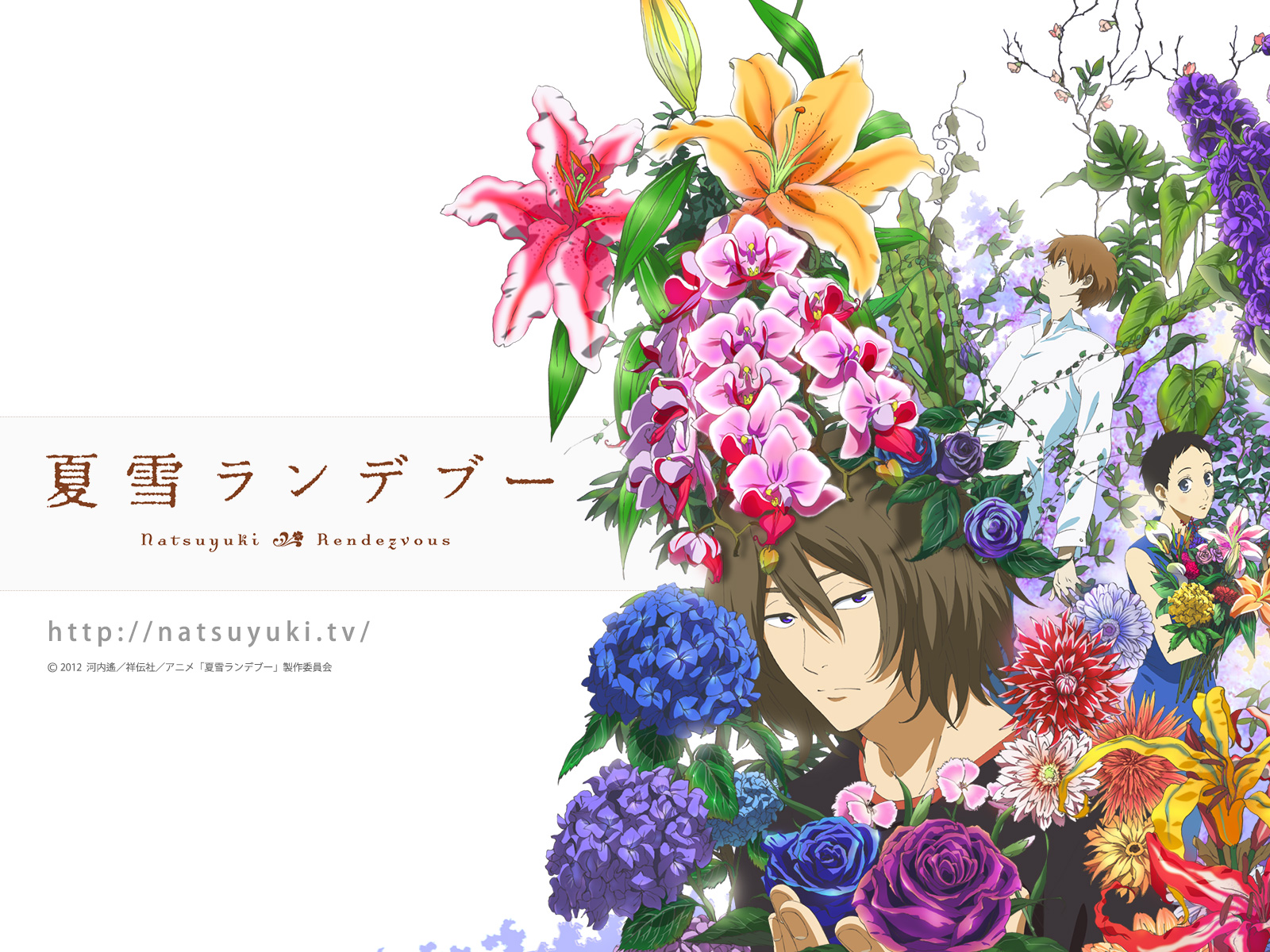
Produced by Doga Kobo, this series depicts a strange love triangle between Ryosuke Hazuki, a young man who falls in love with Rokka, the manager of a flower shop, and Atsushi Shimao, the ghost of her late husband who haunts her.
The greatest appeal lies in its psychological depiction, which balances the heavy theme of “bereavement” with an exquisite mix of humor and heartbreak. Hazuki’s tenacity to confront the ghost—who represents the beloved’s “past”—and live in the “present,” along with the sense of loss felt by those left behind, presses upon the viewer’s chest amidst the vivid colors of the flowers. It is a beautiful yet bitter masterpiece.
“I don’t need to choose flowers for an offering; just being by your side is enough.”
Ryosuke Hazuki is a young part-time worker at a flower shop. He has a scary glare but is single-minded and pure-hearted. He secretly harbors feelings for the shop manager, Rokka Shimao. After falling in love at first sight, he frequented her shop until he used a job opening as an opportunity to work there. Although his wish to work there came true, Rokka, who is eight years his senior, seems to have given up on love. Hazuki feels increasingly frustrated that he can’t do anything despite being right in front of her.
One day, he is called to her apartment on the second floor of the flower shop for an errand, only to find a half-naked man there. Half indignant at this unexpected situation and half dumbfounded, Hazuki soon learns a surprising fact. The man is not her live-in boyfriend, but the ghost of her late husband, Atsushi Shimao. Shimao (the ghost), who is apparently invisible to Rokka, meddles in Hazuki’s love life at every turn. Hazuki refuses to give in and persists with his approach, but gets nowhere. In the midst of this, Shimao (the ghost) makes an unexpected proposal…
“I fell in love with a flower shop manager, but her late husband’s ghost was haunting her.”
Hearing just the summary, it might sound like a slightly quirky fantasy romantic comedy. However, the anime Natsuyuki Rendezvous, broadcast in the “Noitamina” block in 2012, is a masterpiece that cannot be categorized by such light words, depicting the abyss of human karma and love.
The protagonist, a young man named Ryosuke Hazuki; the widowed manager, Rokka Shimao; and her late husband possessing her, Atsushi Shimao. What these strange three (or two and a ghost?) weave is not a bittersweet romance pattern, but a stinging dialogue of souls where the sorrow of bereavement, the guilt of the survivor, and the obsession born of love intertwine.
Even now, more than 10 years after its broadcast, this work continues to stick like a thorn in the hearts of many fans. Why are our hearts shaken so much by this quiet and calm story? Today, from the perspective of a veteran columnist, I would like to dig deep into the richness of the animation that fills the margins of the original work and the “conclusion of love” that the characters chose.
What cannot be avoided when talking about this work is the existence of the ghost husband, Atsushi Shimao. He is not merely a “nuisance to love.” The regret of having to leave his wife young due to illness, the despair of being shown from a special seat how the woman he loves is attracted to a man other than himself (Hazuki). The emotions he holds are too human and compelling.
What appears as a shocking keyword in the story is Shimao’s wish: “I want you to eat my bones.” At first glance, this might look like a crazy, grotesque love. However, when compared with the “folktale of the woman who loved a tree” told in the work, we can see a wish so pure it hurts: “I want to be together even if reborn” and “I want to become a part of her.”
Also, the flashback scene where Rokka licks Shimao’s back. To Shimao who refuses saying “It’s dirty,” Rokka replies, “It smells like an animal.” A wife who lovingly accepts the body of her husband who couldn’t even take a bath due to his battle with illness. There was a raw form of love between living humans that wasn’t just pretty words. By becoming a ghost, Shimao lost the body, the “means to convey love.” That is why he wanted to touch Rokka even if he had to borrow Hazuki’s body. He wanted to spin time with her even if he had to create a fantasy world like a picture book. His childish pranks and jealousy are all screams of his soul saying, “I still want to be here” and “I don’t want to be forgotten.”
On the other hand, the stance of the protagonist, Ryosuke Hazuki, is also filled with an eccentric “love.” Normally, one would want the late husband of the woman they love (especially if he is right there as a ghost) to pass on and disappear as soon as possible. However, he chooses the path of accepting Rokka along with the existence of Shimao.
Symbolic is the line, “I can eat the husband too.” This is nothing but the ultimate proposal to live carrying everything: Rokka’s past, her lingering affection for Shimao, and even Shimao’s own wishes. Seeing the bite mark (mark of jealousy) left on Shimao’s neck, he wishes to love in the same way. Without this depth of Hazuki’s heart, or perhaps a strength that could be called “insensitivity,” this story would have ended as a grim mudslinging drama.
By lending his body to Shimao, he relives Shimao’s perspective and emotions. Beyond the position of “rival,” a strange empathy and understanding are born as men who loved the same woman. The reason this triangle relationship did not become a mere scramble but reached a sublime realm where they respect (or give up on) each other is largely due to the character of the man named Ryosuke Hazuki.
The conclusion of the story was not flashy, but it left a deep lingering finish.
In the end, Shimao could not make Rokka happy with his own hands. However, he was able to fulfill the final dialogue (rendezvous) by borrowing Hazuki’s body and push Rokka forward. “Making Rokka happy.” That meant not becoming a chain that binds her himself, but letting go so she could walk a new life.
The last scene. Time flows, the aged Rokka passes away, and until the moment Hazuki also fulfills his natural life span, Shimao continued to watch over them. Shimao speaks to the grandchild who looks just like Rokka, “Try calling me Grandpa.” There is no longer the intense jealousy or lingering regret as before. There was a gentle figure of passing on, mixed with gratitude to Hazuki and Rokka for fulfilling his dream of “having a grandchild” which he could not fulfill, and a little self-deprecation and humor.
The title “Natsuyuki” refers to the Natsuyuki grass (Cerastium tomentosum / Snow-in-summer). The flower language is “Happiness,” “Talent,” and “Unexpected Encounter.” The existence of Atsushi Shimao might have been exactly like the Snow-in-summer for both Rokka and Hazuki—a beautiful, ephemeral encounter that changed their lives.
This work sublimated the simple depiction of the original into a dense drama by fleshing it out with direction unique to animation, emotional songs by Aimer and Yuya Matsushita, and the acting of talented voice actors such as Yuichi Nakamura, Sayaka Ohara, and Jun Fukuyama. It is sad and poignant, but a quiet warmth remains in the chest after watching. It can be said to be a supreme romance animation for adults.
Natsuyuki Rendezvous throws a heavy question at us. If the person you love continues to have strong feelings for someone other than you. If that person is a deceased person who can never be met again. Can you accept all of that and still love them through?
Hazuki-kun’s almost forceful pure love, the pain of loss Rokka-san carries, and Shimao-kun’s overly sad egoism. Depending on which perspective you stand on, the view of this work changes significantly. If you watch it when you are young, you might empathize with Hazuki-kun, and if you watch it after aging, you might shed tears at the emotions of Shimao-kun and Rokka-san.
Thick passion lurking in a plain daily life. If you are looking for a deep human drama that is not an easy happy ending but has more flavor the more you chew, this work should undoubtedly become a “lifelong piece.”
When the Snow-in-summer sways at that flower shop front. Their rendezvous might still be continuing somewhere even now.
©2012 河内遙/祥伝社/アニメ「夏雪ランデブー」製作委員会