What "Just Because!" Revealed About "Somehow" — The Restlessness of Exam Season and the Distance of Chasing Someone's Back
tarumaki
Enter the Moment
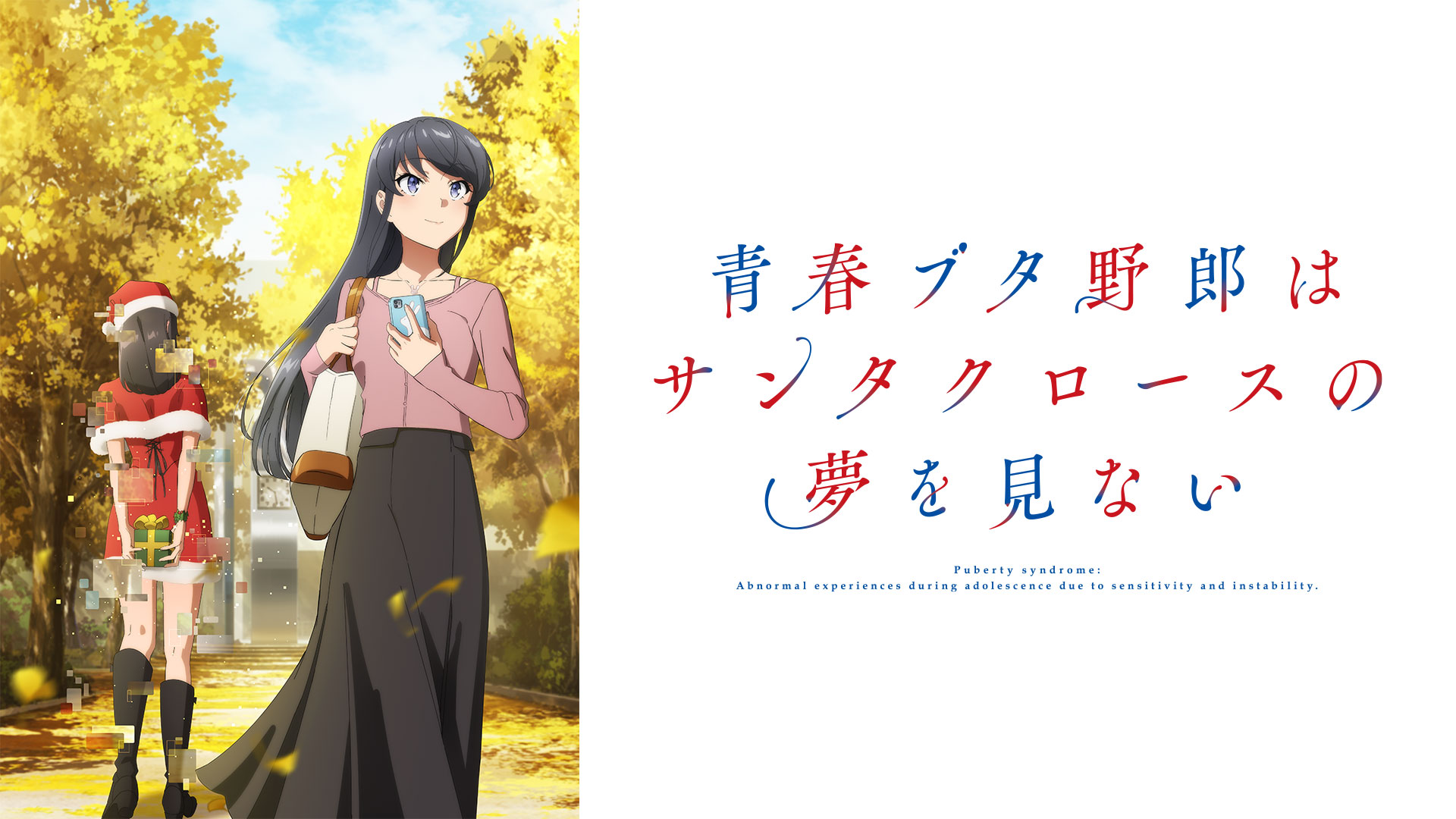
This story depicts the shadow of “Adolescence Syndrome” creeping up once again on Sakuta, just as he plans to spend a peaceful Christmas Eve with his girlfriend Mai and friends.
The greatest appeal lies in its structure, which questions the nature of kindness—“sacrificing oneself for others,” a theme depicted throughout the previous stories—at an even deeper level. Behind the word “Santa Claus,” symbolizing miracles, lie the cruel choices Sakuta faces and the bonds of friends who support him. Amidst the cold, clear air of winter, the heartbreak and preciousness of wishing for a loved one’s happiness light a deep, warm flame in the hearts of viewers.
Adolescence Syndrome— A mysterious phenomenon rumored to be caused by unstable mental states.
Sakuta Azusagawa, who met various girls suffering from Adolescence Syndrome during his high school days, has now become a university student. Having enrolled in a university in Kanazawa Hakkei together with his girlfriend, the nationally popular actress Mai Sakurajima, he spots a mini-skirt Santa on campus—completely out of season.
“I’m surprised. You can see me.” A line that sounds familiar.
The mini-skirt Santa, claiming to “gift” Adolescence Syndrome, tells Sakuta: “…My name is Touko Kirishima.”
Prophetic dreams trending on social media, an unidentified net singer, poltergeists… Along with these mysterious phenomena, a strange story involving girls with wavering hearts begins again. Adolescence does not end—
“Santa Claus doesn’t exist.” The moment we realized that, we became a little more like adults, and at the same time, felt a sense of loss as if we had lost something precious.
Rascal Does Not Dream of Santa Claus. This is the long-awaited sequel to the smash-hit series Rascal Does Not Dream (Aobuta), marking the opening of a new chapter where the stage shifts from high school to university. Let me be honest. The retort, “You’re a university student and still have ‘Puberty’ Syndrome!?” is something every viewer must have harbored at least once (laughs). However, when we opened the lid, what did we find? Depicted there was a story of “adults who can’t quite become adults,” even more complex and bittersweet than the high school days, and one that everyone cannot help but empathize with.
The sensation of being buried after a university debut, despite being a standout in high school. The frustration of wanting to be someone but becoming no one. The skill with which the series vividly depicts such real pain through the SNS phenomenon of “#Dreaming,” the mysterious songstress Toko Kirishima, and the “anomaly” of the Mini-Skirt Santa is simply masterly.
Today, from the perspective of a veteran columnist, I will unravel the depths of the drama woven by the cunning composition and new heroines of this work as it accelerates toward the series conclusion.
One of the themes of this work feels like “peer pressure within a group and the escape from it.” What was particularly impressive was the episode of Ikumi Akagi. When Sakuta was bullied and isolated in the past, she couldn’t do anything. That was because she couldn’t resist the monster named “Class Atmosphere.” However, now a university student, she takes certain actions within the closed group of a junior high school reunion. Reflecting on her past self and trying to correct past mistakes, I saw “justice” in her figure. The ease of flowing with the group versus the difficulty of resisting it. This is a universal theme that pierces not only students but also us who have gone out into society.
Also, new heroines like Uzuki Hirokawa and Sara Himeji are struggling and agonizing over their respective “places” and “roles.” Their value within an idol group, the self within the relationship between a cram school teacher and a student. Because their worries are more compelling than those of high school days and solutions are harder to see, they leave deeper claw marks on the viewers’ hearts.
The presence of the absolute heroine throughout the series, Mai Sakurajima, is alive and well in this work… no, it has increased even more. The scene where she becomes a university student, gets a driver’s license, and takes Sakuta for a drive. The atmosphere flowing inside that car has reached the realm of a mature married couple rather than a newly dating couple (laughs). Sakuta receives direct approaches from the new heroines appearing one after another, but before Mai-san’s rein handling (hold feeling), he doesn’t let us feel even a speck of worry about cheating. The composure and tolerance unique to an older girlfriend, and the cuteness she shows occasionally. It is also the real thrill of this series to be made to realize again, “Mai-san is the strongest after all.”
On the other hand, Sakuta also shows solid growth through his part-time job as a cram school teacher. From the way he teaches students and snuggles up to their worries, it is conveyed that his past experiences of worrying and suffering have become nourishment. His sister Kaede is also cheerfully working part-time at a family restaurant, and I cannot help but feel deep emotion like a relative uncle at the fact that their “daily life” is steadily moving forward.
And the key to this work is the “Mini-Skirt Santa” visible only to specific people and the mysterious songstress “Toko Kirishima.” Santa Claus walking around distributing Puberty Syndrome (presents) to everyone. That existence itself feels like “irony towards adults who stopped believing” and at the same time “salvation reminding them of past dreams.” Reina Ueda’s acting is also exquisite, perfectly establishing a character who is elusive and attacks the line of being annoying, yet somehow cannot be hated.
The story continues to the movie version to be released next year, with the true identity of Toko Kirishima not fully revealed. “Puberty Syndrome is not over yet.” This message feels like a metaphor that saves the “lingering regrets” not only of the characters in the work but also of us viewers who do not want the work Aobuta to end.
Who exactly is Toko Kirishima? What will happen to Sakuta and Mai’s future? Until the concluding chapter where all mysteries are unraveled, we will likely continue to be rolled perfectly on the palms of the production team. But that is also comfortable. That is the awesomeness of the work called Aobuta.
Rascal Does Not Dream of Santa Claus is not just a sequel. By daring to expand the story that could have ended beautifully in the high school arc to the university student arc and fully depicting the pain and lingering regrets in the process of becoming an adult, it pushed the depth of the series up a notch.
Stable animation by CloverWorks, passionate performances by elite voice actors, and musical pieces such as the OP “Snowdrop” by Conton Candy and the ED “Suiheisen wa Boku no Furukizu” (The Horizon is My Old Wound) sung by the heroines in turn. All these elements fuse at a high level, inviting us once again to the world of “Fukashigi no Karte” (Mysterious Chart).
The next movie version will be the series conclusion. No matter what ending awaits, I am prepared to watch the whereabouts of Sakuta and his friends’ youth until the very end. Everyone, let’s dream together at the theater.
(C)2018 鴨志田 一/KADOKAWA アスキー・メディアワークス/青ブタ Project