“My Dress-Up Darling” — The Courage to Be Yourself and the Beauty Beyond Appearances
tarumaki
Enter the Moment
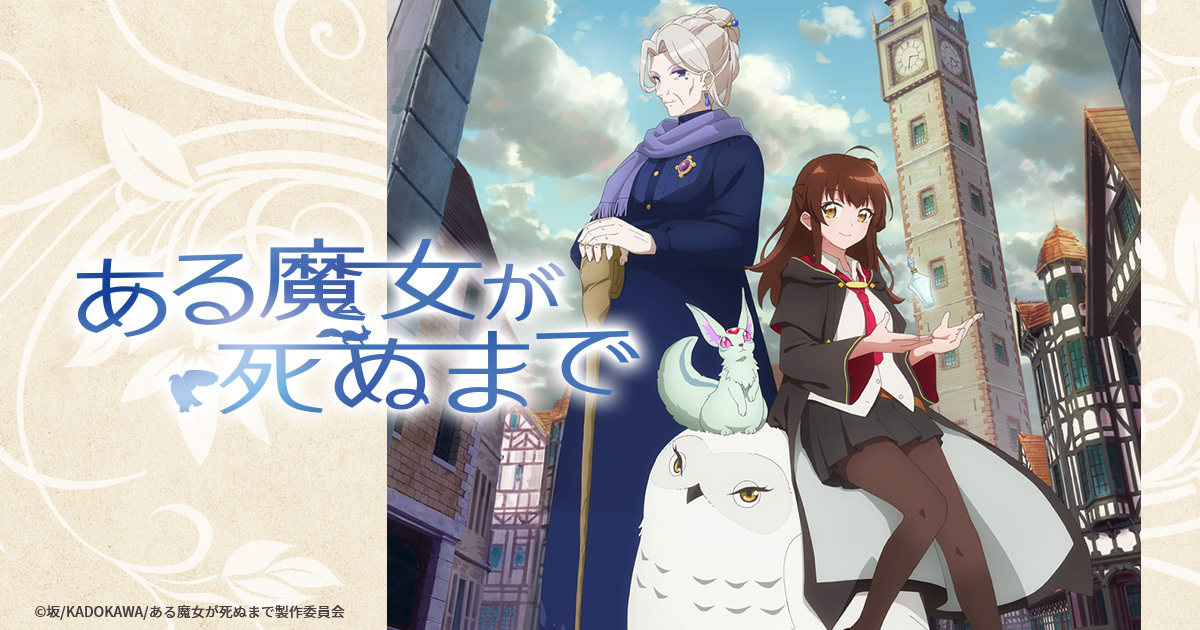
This fantasy series depicts the daily life of Meg, a girl inheriting the blood of the “Witch of the End” who is destined to reach the end of her lifespan at age 17, and her mentor, the witch Faust.
The greatest appeal lies in the careful depiction of days spun calmly yet lovingly, even in the face of absolute death. Rather than lamenting her remaining time as a tragedy, Meg’s devoted figure—using magic for the sake of others and trying to carve out memories—invites tears from viewers. Accompanied by beautiful background art, this gem of a touching story will shake your heart with the radiance of life’s extinguishing light and the thoughts left for those who remain.
“You’re going to die in one year.”
On her 17th birthday, apprentice witch Meg Raspberry is suddenly told by her mentor, Faust—the “Eternal Witch” who ranks among the top of the magical world as one of the Seven Sages—that she has only one year left to live. Meg had been under the curse of the “Death Sentence.”
There is only one way to escape death from the curse. To create the “Seed of Life,” which grants immortality to whoever possesses it. And the ingredient for the “Seed of Life” is a fragment of emotion—tears of joy, shed when people are happy.
“So, how many tears exactly do I need to collect?” “One thousand people’s worth.” “…Huh?”
Thus, Meg begins interacting with various people to collect tears of joy. Her childhood friend and best friend, Fine. Another of the Seven Sages like Faust—Inori, the “Witch of Wisdom.” A genius girl the same age as Meg who is also one of the Seven Sages—Sophie, the “Witch of Blessing.”
This is a story of miracles caused by Meg Raspberry, an apprentice witch who has been sentenced to one year left to live.
“Until the Death of a Certain Witch” (Aru Majo ga Shinu Made). I am surely not the only one who felt a chill run down my spine the moment I saw this title. These words, leaving a strong impact at first glance, mercilessly thrust upon us a conclusion of “death” that the story to be told cannot avoid. Many viewers likely imagined a tragic end or a tear-jerker story that couldn’t be watched without weeping.
However, what happened when we opened the lid? Running around on the screen is Meg Raspberry, a 17-year-old girl who fires off dad jokes and laughs innocently. Her brightness and vitality make you want to ask, “Did you really receive a terminal diagnosis?” However, behind that smile lived a tough spirit betting on the remaining 1% hope, and a fleeting beauty trying to accept her own fate.
This work is not one that sells itself on hyper-technical animation or flashy action. However, the “philosophy” and “love” at the core of the story, along with the passionate performances of the voice actors and the power of the music, leave a quiet but deep mark on the viewer’s heart. It exudes the style of a “hidden masterpiece.” Today, from the perspective of a veteran columnist, I would like to unravel the depths of this seemingly contradictory work—a story heading towards death, yet overflowing with the joy of living.
The introduction of the story is simple yet cruel. A “curse of death” activates on her 17th birthday. Remaining life expectancy: one year. The only way to survive is to collect 1000 “fragments of joyful tears” and make the “seed of life” sprout. Thinking normally, this is an “impossible game” (kusoge). It calculates to needing to collect an average of over 2.7 joyful tears per day. In modern society, opportunities to see others’ tears of joy are rare. If it were me, I might give up early and spend the remaining time in desperation.
However, Meg does not give up. This “refusal to give up” is her greatest charm and the engine that drives this work. Initially, she begins selecting “targets likely to shed tears” with a method bordering on that of a con artist (or perhaps marketing) to collect tears efficiently. While her desperation to live is conveyed, a dilemma arises: “Is there true value in salvation without heart?”
In the middle of the story, she realizes her mistake and begins to reach out to people in trouble without calculating profit or loss. Meg’s growth here was magnificent. Also, the scene where she tells her best friend Fine about her impending death. Smiling, yet serious. Is there any coming out so cruel yet so full of love? Fine breaking down in tears on the spot was precisely because she had a relationship of trust where Meg “doesn’t lie.” And because Meg herself was convinced that her relationship with Fine wouldn’t change. There is an aesthetic of “hiding it because you don’t want to make your loved ones sad,” but Meg’s choice was “to remain equals until the end.” This sincerity strikes the hearts of viewers.
I must also mention the acting ability of Yoshino Aoyama, who played the protagonist Meg. A cheerful and strong-willed character, 180 degrees different from her representative role as Hitori Gotoh in Bocchi the Rock!. Yet, the fear of death and loneliness shown in fleeting moments. Her acting, which felt like a real human being with no lies, was a pillar supporting the reality of this work.
The reason this work doesn’t end as a mere fantasy lies in the sharpness of its view on life and death. Especially in Episode 2, Grandma Claire’s episode burst the tear ducts of many anime fans.
Meg sees a “black mist” clinging to those near death. Seeing it, she runs around trying to save her somehow. However, her master Faust admonishes her, “You must not change the fate of death.” This is a heavy theme that connects to medical ethics and the issue of “end-of-life care” that we face. No matter how much we struggle, people will die someday. Neither doctors nor wizards can overturn that logic.
However, the answer Meg arrived at was to “let her meet her estranged son.” Even if she couldn’t extend her lifespan, she could change her final moments from lonely ones to ones wrapped in love. Faust’s line, “You were able to change the shape of death,” can be called one of the best quotes of this work. The scene where Grandma Claire peacefully falls asleep was sad but warm and full of salvation. Because Meg was by her side, her final days became lively and colorful.
Also, the episode of the father, Ted, who tried to dabble in devil worship, was intense. The madness of trying to sacrifice his family, whom he should love the most, for revenge against his company. His words, “Family is no support, they just corner me,” sent chills down my spine as they seemed to reflect the darkness of modern society. Unable to show weakness to his family, who should be his greatest allies, he corners himself and resents them. That is not “love,” but twisted self-love. Through this episode, Meg (and we) are asked again, “What do we live for?” and “For whom do we use our power?”
Furthermore, in the episodes of the spirit of the Sacred Tree, Serena, and the girl suffering from magical pollution, Meg continues to fight against “unreasonable reality.” The logic of “triage (selection of life)” preached by the Sage of Life, Jack Russo, may be correct for a doctor. But Meg struggles, saying, “I want to save everyone.” The catharsis where that idealistic naivety causes a miracle (Thetis’s Bell). You could call it opportunistic, but because it is a story premised on the absolute despair of death, this “struggle” shines.
The anime version depicted up to a major break in the story, but the biggest mysteries—whether Meg’s curse will be broken and whether she can survive—closed the curtain without a clear resolution. Some may feel unsatisfied with the “read the original novel for the rest” ending. However, personally, I feel this lingering finish isn’t bad.
In the second half, the story expanded into a magnificent spectacle involving the secret of Meg’s birth, the connection with the Worst Witch Eldora, and the destruction of her hometown, Orloff. The chain of revenge Eldora carries. The love and guilt Master Faust holds for her disciple. It is often said that “revenge begets nothing,” but knowing the wounds Eldora received, we cannot simply condemn her. This work carefully tried to depict the entanglement of complex emotions that lie beyond good and evil.
To be honest, regarding animation quality, there were scenes where I had to say it was average or below. However, what more than makes up for it is the power of “Sound” and “Story.” Especially the ending theme, Aoi Teshima’s singing voice. Her unique sound, which is like a requiem and a mother’s lullaby, gently wrapped the sadness and hope that visited at the end of each episode, pushing the dignity of the work up a notch. Just by that song playing, this work takes on the atmosphere of a “masterpiece.”
Meg sets out on a journey to explore her roots at the end. It is not a journey to escape the fear of death, but a journey to know who she is and decide how to live her remaining time (or, the future she will win). The “tears of joy” she collected became her own power to live and changed the people around her.
Until the Death of a Certain Witch may not be a “perfect anime” that can be recommended to everyone unconditionally. Flaws are visible in the instability of the animation and the rapid developments in the second half. However, it is packed with charm that allows me to declare, “The good parts are exceptionally good.”
By being conscious of death, life shines. How the ordinary daily life is a series of miracles. The way of life of a single girl named Meg Raspberry throws a strong message to us who tend to spend our days in inertia.
“Did you make someone smile today?” “Did you live today so you won’t have regrets?”
If there is anyone tired of daily life and about to lose the meaning of living, I want them to watch this work. You will smile wryly at Meg’s dad jokes, shed tears at her single-mindedness, and in the end, surely receive the courage to look forward just a little bit.
I don’t know if there will be a second season or if it will conclude in the original work. However, I cannot help but wish for Meg’s journey to have a happy ending. Because she has already become a “precious friend” to us as well.
©坂/KADOKAWA/ある魔女が死ぬまで製作委員会