“Waiting in the Summer“ — A Nostalgic and Heartfelt Portrait of Youth
tarumaki
Enter the Moment
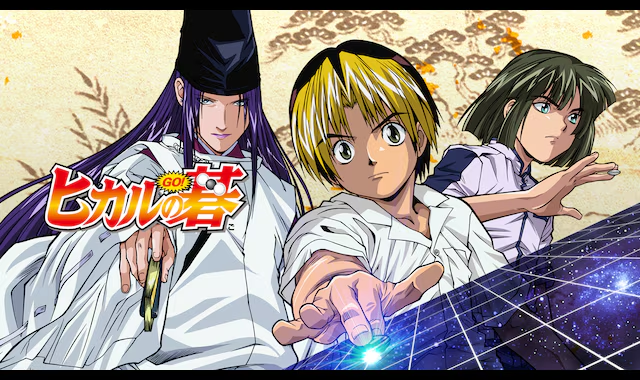
Produced by Studio Pierrot, this series tells the story of Hikaru Shindo, a boy possessed by the spirit of a genius Go player from the Heian period, Fujiwara no Sai. Guided by his destiny with his rival Akira Toya, Hikaru steps into the unknown abyss of the Go board.
The greatest appeal lies in the directing power that transforms seemingly plain “matches” into extreme psychological battles where souls collide. The solitude and passion of the seekers chasing the “Divine Move” (Kami no Itte), and Hikaru’s growth as he becomes independent after his parting with Sai, burn hot in the hearts of viewers. It is a masterpiece that breathed new life into traditional culture and moved an entire generation.
Hikaru Shindo is an ordinary 6th grader who loves sports and hates using his head. One day, he finds an old Go board at his grandfather’s house. Noticing a bloodstain on the board, Hikaru becomes possessed by the spirit of Fujiwara no Sai, a genius Go player from the Heian period who resided within it. Sai, who met a tragic end, reveals that he had previously possessed the Go Saint, Honinbo Shusaku.
Although Hikaru knows neither the rules nor the history of Go, he begins to play the game, urged on by Sai, who seeks to master the “Divine Move.”
“Go? Isn’t that the game old men play on the porch?” “The rules look complicated; I wouldn’t understand what’s happening.”
If you are avoiding the masterpiece anime Hikaru no Go for such reasons, I want to say this loudly: “That is a grave loss in your life!” Let me assert this first: You can enjoy this work 100%—no, 120%—without knowing a single thing about Go rules.
The protagonist, Hikaru Shindo, starts as an ordinary elementary school student who doesn’t know the first thing about Go. The story begins with him learning how to hold the stones, and the viewer is drawn into the infinite universe spreading across the board alongside Hikaru. I myself only knew about Gomoku (Five in a Row), but by the time I finished watching, I was in a state of excitement, thinking, “Go is this hot, interesting, and cool!?” and almost ran out to buy a Go board.
This is not just a board game anime. It is a magnificent saga depicting the encounter between the ghost of a genius Go player from the Heian period and a modern boy, their mutual improvement, and the eventual “parting” and “succession.” It is a supreme youth mystery and a story of spiritual growth. It is a long series with 75 episodes, but once you start, you can’t stop. From the perspective of a veteran columnist, and mixing in the passionate thoughts of fans, let’s unravel the charm of this masterpiece that is truly a “time thief.”
What is absolutely essential in talking about this work is the existence of Fujiwara no Sai, the ghost from the Heian period who possesses the protagonist, Hikaru. Many viewers had their hearts stolen by Sai. First of all, his visuals are magnificent. Clad softly in Kariginu robes, with long flowing hair and wearing a tall Eboshi hat, he is bewitching and sexy like a Shirabyoshi dancer. Even from the perspective of modern anime, his character design is exceptionally excellent.
Sai once served as a tutor to the Emperor but lost his life in the middle of his ambitions. In the Edo period, he possessed Honinbo Shusaku and claimed the title of the strongest. He is, so to speak, the “strongest cheat character in the Go world.” The coolness with which he displays demon-like strength when facing the board, declaring, “If I hold Black, I have never lost.” On the other hand, the cuteness with which he throws tantrums at Hikaru saying “I want to play Go!” and his curiosity about modern civilization. This gap is irresistible.
However, Sai is not just an “overpowered” plot device. He was also the greatest “Master.” When Hikaru is crushed by his own weakness, Sai never scolds him, nor does he offer cheap comfort, but gives him words to move forward. “That determination is well worth the price of one or two losses.” Because of Sai’s guidance, Hikaru steadily gains strength, shedding his skin from being merely “Sai’s puppet” to becoming an “independent Go player.”
And then, the “Parting with Sai” that visits in the middle of the story. This brought a trauma-level sense of loss to many anime fans. Some real-time viewers at the time were so shocked by Sai’s disappearance that they stopped watching. Hikaru also despairs at the sudden parting and quits Go once. However, the revival drama from there is the true essence of this work. During a certain match, Hikaru realizes: “Sai is within the Go I play.” “I existed for Hikaru. Then Hikaru, too, must exist for someone else.” Even if Sai disappears, his soul and playstyle are surely inherited within Hikaru. A baton connected over 1000 years. The scene where Hikaru tearfully says, “I’m not Sai… unfortunately,” oozes with the boy’s independence and the resolve to live with the sadness of loss, and cannot be watched without tears.
What makes Hikaru no Go a “Jump Royal Road of Friendship, Effort, and Victory” is the existence of the fated rival, Akira Touya. The son of the top Go player, Toya Meijin, Akira is a genius boy who has received gifted education since childhood. With his bobbed hair, sharp gaze, and a demeanor that puts adults to shame even as an elementary schooler, he is a stoic hard worker reminiscent of Ayumi Himekawa from Glass Mask.
The encounter with Hikaru (technically Sai) was a shock for Akira. There is someone his age stronger than him. That fact drives him, and he chases Hikaru with a rivalry that could be called obsession. On the other hand, Hikaru, who was initially uninterested in Go, gets serious as if infected by Akira’s passion, and this time begins to chase Akira’s back with fierce momentum.
Their relationship is exactly “chasing and being chased.” Even when they are in different places, they are always conscious of each other. That intense magnetic field creates the illusion that we are watching a love story. “Shall we play now, instead of someday?” Akira’s obsession with Hikaru is sometimes borderline madness, but it is also proof that they recognize each other as “one and only.”
The voice acting is particularly wonderful. The change in acting expressing the voice change as they grow from elementary school students to junior high students is nothing short of magnificent. The tense atmosphere during matches, the hand movements when placing stones, the breathing. The battle on the board, which has no flashy action, takes on a tension like a life-or-death exchange through their acting. Tomoko Kawakami’s performance as Hikaru—energetic but somewhat delicate—is deeply moving even now and warms the heart.
The greatness of Hikaru no Go is not just limited to the two protagonists. The characters surrounding Hikaru are incredibly charming and human.
The caring big brother figure Kaga, and fellow Insei (Go institute students) Waya and Isumi-san. Especially Isumi-san’s episode resonated with many readers and viewers. He has ability but is mentally weak and stumbles in the pro exam. The figure of him returning grown after a warrior’s journey to China is no exaggeration to say he is another protagonist. Also, the wholesome dedication of Shirakawa-sensei watching over Hikaru’s growth and Akari-chan warms the heart.
And the story expands from the level of school clubs to Insei, pro exams, and the world of top pros. The harshness of the world of competition, impatience with age limits, the pride of adults. It is not “just a board game.” The joys and sorrows of gamblers who have staked their lives are condensed there. The online Go match between Sai and Toya Meijin was a famous scene filled with romance and excitement unique to the dawn of the internet, watched with bated breath by strong players around the world.
Although the anime version does not depict up to the complete ending of the original manga (the end of the North Star Cup), it is beautifully wrapped up as a single work. The theme songs are also masterpieces. Especially the first OP, “Get Over” by dream, is a “God Song” where the lyrics “Fly higher and higher” link perfectly with the relationship between Hikaru and Sai and the feelings of Go players aiming for heights, raising the tension just by listening.
Hikaru no Go is not just a Go anime. It is a story of “feelings” passed down from the past to the future.
Why did Sai stay in this world for 1000 years? It was to master the “Divine Move” (Kami no Itte). However, that wish was not fulfilled by his own hands. But the passion and the moves he entrusted to Hikaru continue to live within Hikaru, and Hikaru, too, will likely pass that baton to someone else someday. Sai’s words, “I existed for Hikaru,” may be a universal form of love that all mentors, parents, and predecessors hold for the next generation.
It’s okay if you don’t know Go. After finishing watching, you will surely be fascinated by the cosmos woven by black and white stones on the board, and you will never forget the names of the main characters for the rest of your life. And you should remember at the cellular level the preciousness of being absorbed in something and the joy of competing with rivals.
To those who haven’t watched it yet, and those who watched it once but stopped halfway. Now is the perfect opportunity to binge-watch this masterpiece. Why not go on a journey aiming for the Divine Move with Hikaru? Emotion and excitement beyond your imagination are waiting there.
Original Creator: Yumi Hotta, Takeshi Obata
Director: Susumu Nishizawa, Jun Kamiya, Tetsuya Endo
Series Composition: Shikichi Ohashi
Character Design: Hideyuki Motohashi (Main), Kanami Sekiguchi, Minako Shiba
Music: Kei Wakakusa
Animation Production: Studio Pierrot
(C)ほったゆみ・HMC・小畑健・ノエル/集英社・テレビ東京・電通・ぴえろ