"Haikyu!! Karasuno High School vs Shiratorizawa Academy" — The Awakening of Kei Tsukishima, the "MVP" Born from the Extreme Battle of One Match in One Season
tarumaki
Enter the Moment
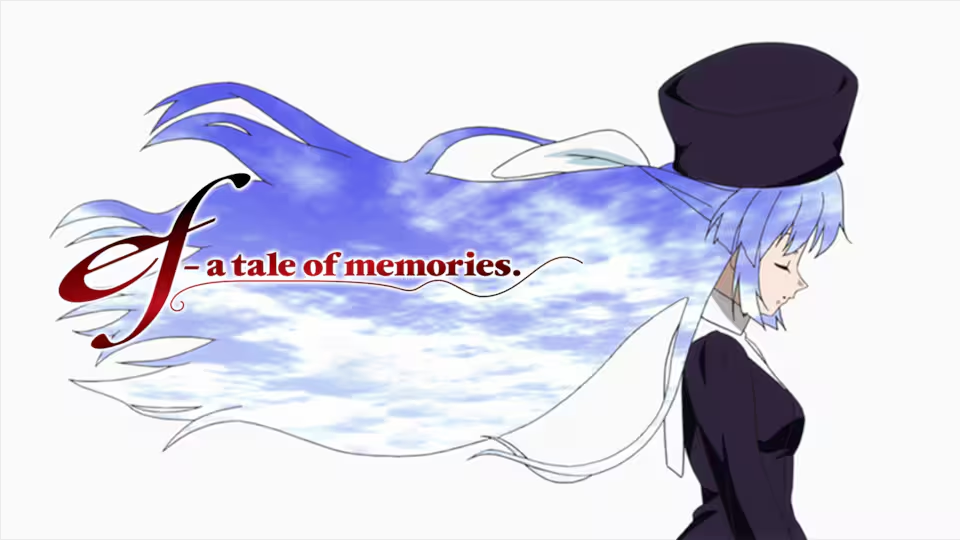
This story depicts the romance between Renji and Chihiro—a girl whose memory lasts only 13 hours (half a day)—as well as the intersecting passions of young men and women set against the backdrops of Germany and Japan.
The greatest appeal lies in its creative direction, which fuses live-action photography with animated graphics. The kinetic typography that slams the heart’s cries onto the screen as text, along with a color design that symbolizes the very hues of emotion, are so vivid they almost numb the viewer’s senses. It is a masterpiece where the yearning of young people—who cling to “writing” or “filming” to leave behind proof of their existence amidst a restrictive reality—pierces the heart painfully.
Hiro Hirono and Kei Shindo are childhood friends. Hiro was invited to Kei’s party on Christmas Eve, but after a chance encounter with Miyako Miyamura, he ends up being dragged around by her free-spirited whims.
Kyosuke Tsutsumi, Hiro’s classmate and a member of the film club, spots a girl in the crowd while filming the Christmas streets. He points his camera at her, but misses the shot.
Meanwhile, Renji Aso meets Chihiro Shindo at a train station. The next day, and the day after that, Renji returns to the unmanned station to see Chihiro again, but…
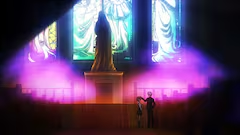

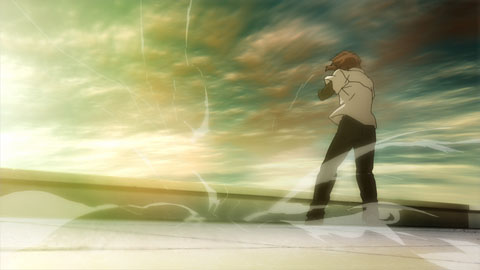
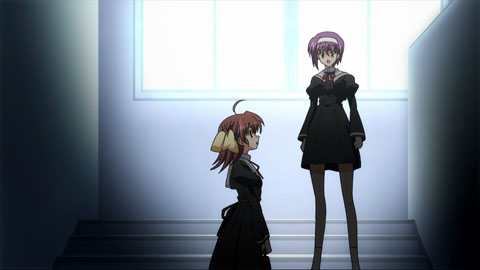
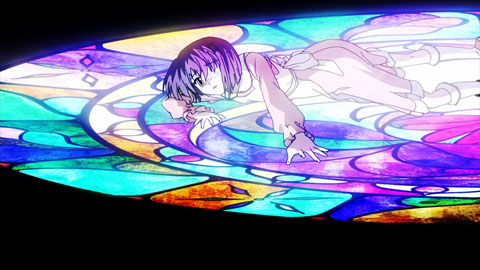
“The Shadow of CLANNAD.” There was a work once whispered by such a name. If CLANNAD, broadcast around the same time, depicted the emotion of “Light,” then ef – a tale of memories. is a work that cut deeply into the “Shadow” parts such as human jealousy, obsession, and the darkness of the heart.
The original work is a visual novel (bishoujo game) by minori. However, this anime version of ef is completed as a piece of “visual art” that far exceeds the framework of a mere promotional anime for a game. The director is Shin Oonuma, and the production is by Shaft. This combination caused a chemical reaction, creating a beautiful yet cruel romantic ensemble drama.
Thoughts of boys and girls intersecting in a certain winter town. The suffering of chasing dreams, the terror of losing memories, and the madness born of love. Today, from the perspective of a veteran columnist, I will thoroughly discuss the profound charm of this masterpiece, which continues to fascinate many fans even more than 15 years after its broadcast.
What is essential in talking about this work is Shaft’s unique and avant-garde direction. In particular, the scene where Miyako Miyamura, one of the heroines, continues to call the protagonist, Hiro, is handed down as a “legendary trauma-inducing direction” in anime history.
Hiro does not come at the promised time. The phone does not connect. “Text” fills the screen along with a sense of frustration. The direction of the incoming call history reaching nearly 100 calls and the answering machine messages expresses the “color” draining from Miyako’s heart painfully vividly. It is a long-take scene that would make you want to retort “It’s too long!” in an ordinary anime, but that “time” itself is a device to make the viewer relive the depth of the loneliness she felt.
Also, the background art and color design are original. Backgrounds that look like they were cut out with a wide-angle lens, and characters placed small therein. This composition suggests that they are tiny beings living in a corner of the world, while simultaneously highlighting the beauty of that worldview. Psychological description is performed more eloquently than dialogue using only text information and changes in color. This can be said to be exactly “expression unique to animation.”
ef – a tale of memories. proceeds with two stories largely in parallel.
One is the story depicting a love triangle between Hiro Hirono, a professional shoujo manga artist, Miyako Miyamura, a free-spirited girl, and Kei Shindou, Hiro’s childhood friend. The other is a sad yet pure love story between Renji Asou, an aspiring novelist, and Chihiro Shindou, a girl who can only retain memories for 13 hours.
The composition where these two axes intersect in an exquisite balance and converge into one major theme is simply magnificent. The anguish as a creator, jealousy towards talent. The harsh fate of memory impairment. The problems each character carries are heavy and serious, but precisely because of that, the “answers” they choose have strong persuasiveness.
Especially, Chihiro’s story cannot be watched without tears. The weight equivalent to “death” implied by the act of tearing up her diary. And her feelings spun out by overcoming it. I take my hat off to the compositional power that depicted such a dense human drama within the limited length of one cour.
And another element that makes this work a masterpiece is “Music.” The background music is handled by Tenmon, known for Makoto Shinkai’s works. The melodies of the piano and strings he plays are infinitely transparent and poignant. Combined with beautiful backgrounds like snowy streetscapes and twilight skies, they quietly but surely shake the viewer’s heart.
The OP theme “euphoric field” is also given a wonderful gimmick. This song, sung with English lyrics, has its video and part of the lyrics change according to the progress of the story. The Japanese version played in the final episode, and the direction where color is added to the monochrome world. All of these are calculated thoroughly, and you can experience goosebump-inducing emotion just by watching the OP. ELISA’s transparent singing voice also matches the worldview of the work perfectly.
The high synchronization rate of music and visuals. This goes beyond the level of simply “using a good song” and is proof that music itself functions as an important factor in telling the story.
ef – a tale of memories. may not be a work that appeals to everyone. Some may show rejection to the strong quirkiness peculiar to visual novel adaptations or the unique direction. However, including its toxicity and pain, this work is undoubtedly “beautiful.”
The conflicts of boys aiming to be creators, the passion of girls going mad with love, and the sadness of living while clinging to the uncertain thing called memory. Shaft’s visual beauty and Tenmon’s music wrap all of them up and sublimate them into a piece of art.
If you are unsatisfied with mere romantic comedies or slice-of-life anime, please pick up this work. There awaits a vivid memory of youth that will gouge your heart deeply and leave unforgettable traces.
And this story continues to the next work, ef – a tale of melodies.. To the second season where all foreshadowing is recovered and further emotion awaits. Why don’t you immerse yourself in this artistic world too?
(C)minori/「ef」製作委員会