The Painfully Pure Realism of Youth Depicted in "true tears" — Searching for the "True Tears" Lost in the Snowy Landscapes of Toyama
tarumaki
Enter the Moment
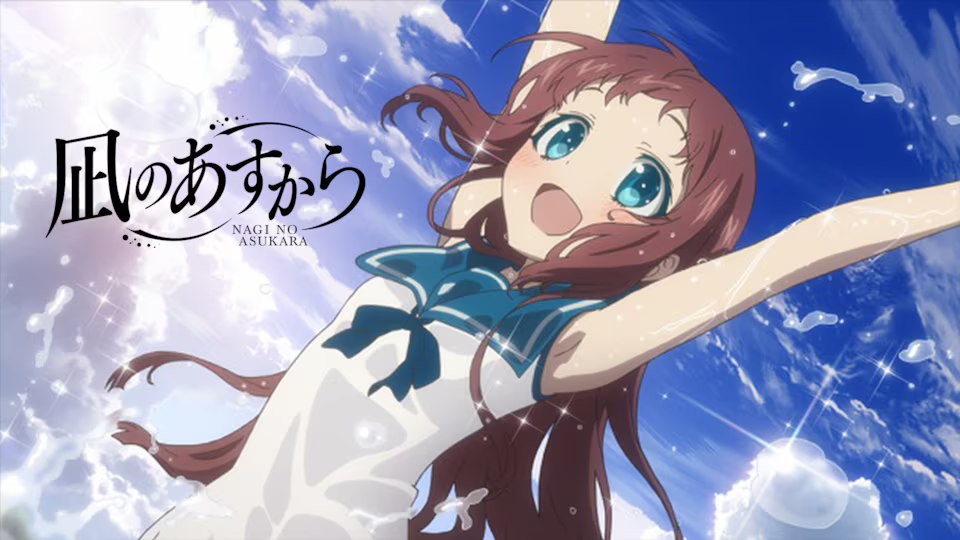
Broadcast from 2013 to 2014, “Nagi-Asu: A Lull in the Sea” (Nagi no Asukara) is an original anime produced by P.A.WORKS. With Toshiya Shinohara as director and Mari Okada handling series composition, the series portrays the “interaction and conflict between humans living in the sea and on land,” woven together with overwhelming visual beauty.
The greatest appeal of this work lies in the complex romantic relationships depicted from multiple perspectives and the dramatic environmental changes that occur midway through the story. Five childhood friends living in the sea village experience admiration, jealousy, and a rejection of change as they interact with the world on land. These emotions are portrayed vividly—and at times, painfully—amidst the fantastical, clear blue scenery of the ocean.
The story is structured in two parts, depicting the world several years after a certain major event. This structure highlights the changes in relationships brought about by the passage of time, as well as the preciousness and pain of continuing to love someone. It is a masterpiece where delicate, unspeakable emotions intertwine intricately like the currents of the tide, leading to a deeply moving conclusion.
Long ago, all humans lived in the sea. However, some people longed for the land and abandoned the ocean. They cast off the special “Ena” (raiment) given to them by the Sea God to allow them to live underwater…
Humans living in the sea and humans living on land. Although their dwelling places were divided and their ways of thinking were incompatible, they were originally the same humans, and so, while slight, their interactions continued as time flowed.
Hikari Sakishima, Manaka Mukaido, Chisaki Hiradaira, and Kaname Isaki live in the sea village on the ocean floor. Tsumugu Kihara lives on the surface. Sea and Land. When these middle schoolers of the same age, who had never met before, finally cross paths, their hearts begin to waver like the ebb and flow of the tide.
This is a blue fantasy (fairy tale) of boys and girls unfolding in a slightly mysterious world.
Does the feeling of “love” alone change the world? Or, in a world that inevitably changes, can the feeling of “love” alone remain unchanged?
Nagi-Asu: A Lull in the Sea (Nagi no Asukara) is an original anime created by the tag team of P.A.WORKS and Mari Okada. Even after more than 10 years since its broadcast, it remains a rare masterpiece that not only refuses to fade but increases in blueness and brilliance. People living in the sea and people living on land. Amidst different environments, different values, and the cruel yet beautiful change of time, the love patterns woven by seven boys and girls go far beyond the framework of a mere “romantic drama.”
Overwhelmingly beautiful animation, overly delicate psychological descriptions, and heart-tightening poignancy. Why is this work often called “P.A.WORKS’ masterpiece”? And why does it pierce so deeply into the hearts of us adults? From the perspective of a veteran columnist, let’s dive deep into the bottom of that sea.
First, what rivets the viewer’s eyes is the overwhelming visual beauty. The depiction of the underwater village “Shioshishio” is breathtakingly beautiful. The shimmering light, the drifting fish, and the blue of the sea reflected in the characters’ eyes. While being a fantasy, there is a reality where you can almost hear the breathing of the people living there.
However, the true value of this work lies in the fusion of “complex human relationships” and “social issues” built upon that beautiful worldview. Conflict and discrimination between people living in different environments of sea and land, and the depopulation of the village due to declining birthrates. These function as metaphors for problems faced by modern society, and cannot be dismissed as mere fantasy works. In particular, the depiction of the sea in the last scene of Episode 18 impressed the turning point of the story vividly with its goosebump-inducing beauty and directing power.
From the slapstick youth drama of the first half, the atmosphere of the story changes completely in the second half (2nd cour). True to the title “A Lull in the Sea,” it goes from the calm sea-like first half to the storm-like turbulent second half. This skillfulness of composition keeps viewers glued to the screen.
The love pattern of this work is, in a word, “complex and bizarre.” Far from a love triangle, it is a state that can be called a “hexagonal relationship” where all seven main characters seem to have unrequited love. Some might feel it is “tedious” or “frustrating.” However, that frustration is exactly the real emotion of adolescence.
“I can’t take a step forward because I don’t want to break the current relationship.” Their conflict is a pain that everyone has experienced at least once. Especially the growth of the protagonist, Hikari Sakishima, is remarkable. In the early stages, he looks like just a short-tempered child, but as the story progresses, he cares for his friends more than anyone else and acquires the strength to move forward without fearing change. Also, the bravery of Miuna Shiodome, who can be said to be the de facto protagonist of the second half, must have touched the hearts of many viewers. The purity of her feeling of “love” strikes at the core of this story.
“Changing” is scary. But we cannot stay unchanged. Such a universal theme is colored by Mari Okada’s unique script, which is a little painful but warm. The highlight is not just enjoying the love puzzle of “who likes whom,” but the subtleties of their hearts as they accept “change.”
What awaits at the end of the long journey of 26 episodes is “satisfaction” beyond a mere happy ending.
Towards the end of the story, all foreshadowing is recovered, and each feeling converges into one answer. Of course, not everyone’s love is fulfilled. If someone’s love bears fruit, someone else will cry. However, this work beautifully affirms even that sadness. “There is no waste in the feeling of caring for someone.” Such a message is conveyed quietly but powerfully from the last scene of the final episode.
Some viewers may voice that they wanted to see more of Kaname’s episodes or found it difficult to empathize with Manaka. However, if we take it as depicting the “imbalance of human relationships” including that, the depth of this work increases. In reality, not everyone can be the protagonist, and feelings are not equally rewarded. Still, they look forward and walk on. Seeing them, we overlay our former selves, shed tears, and feel a little saved.
Nagi-Asu: A Lull in the Sea is a work that adults, as well as middle and high school students, should definitely watch. The stinging pain of love experienced in the past. The loneliness toward the changing hometown and friends. And the strength to live on despite everything. All of them are packed in this beautiful blue world.
The OP and ED songs are also wonderful and permeate the heart in accordance with the development of the story. If you haven’t seen this work yet, that is very lucky. Because you can experience that emotion for the first time from now on.
Whether you love the sea and are in it all year round or not. Once you dive into this sea of “Nagi-Asu,” you will surely encounter unforgettable scenery. And after watching, you will surely want to convey your feelings to your precious person. Saying, “Changing isn’t so bad, is it?”
(C)Project‐118/凪のあすから製作委員会