Don't Let the Title Fool You! "Rascal Does Not Dream of Bunny Girl Senpai" Reveals the Painfully Honest Truth of Adolescence
tarumaki
Enter the Moment
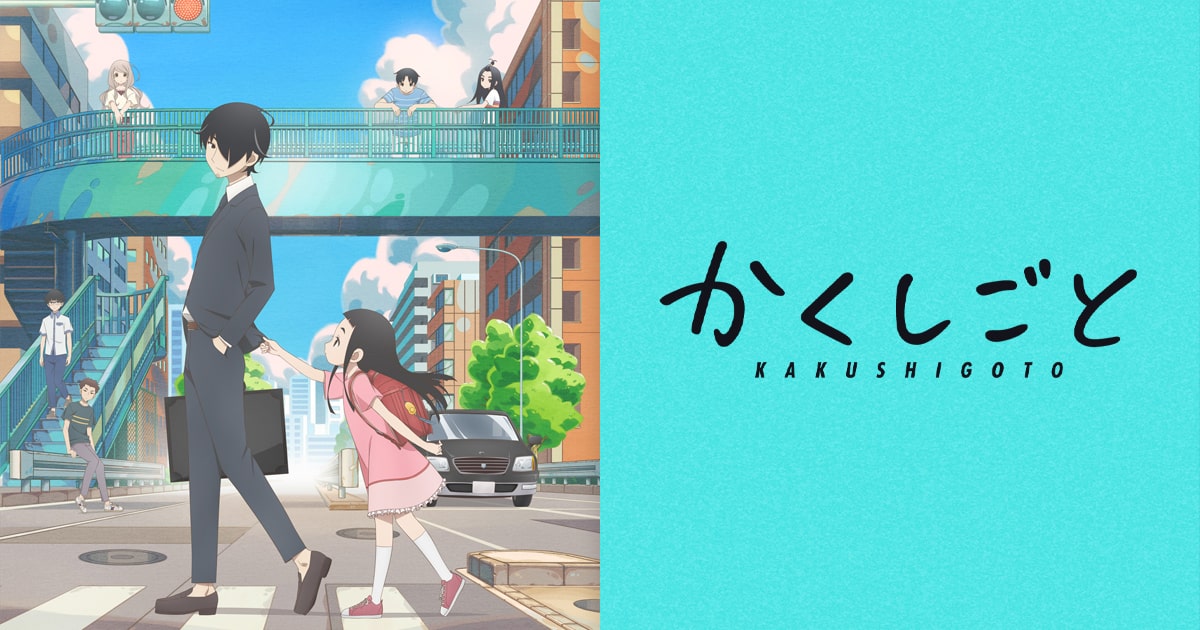
About the Work Based on the manga by Koji Kumeta, known for works such as Sayonara Zetsubou Sensei, “Kakushigoto” was adapted into an anime in 2020. The title holds a double meaning: “Kakushigoto” (Secret), which the father keeps from his child, and “Kaku Shigoto” (Job of Drawing), referring to the father’s profession.
The story does not end as a mere comedy; scenes of the “18-year-old Hime” in the future are inserted at the beginning or end of each episode. These scenes depict the grown-up Hime gradually getting closer to the truth of her father’s secrets. Heartbreaking mysteries that touch upon the core of the story—such as why her father went to such lengths to keep his secret, and what happened to her mother—are slowly revealed.
Do you have a secret?
Kakushi Goto is a manga artist who draws somewhat raunchy manga. His only daughter, Hime, is a 4th grader in elementary school. For Kakushi, his beloved daughter Hime comes first in everything. However, there is one thing this doting father does not want Hime to know. That is the fact that his job is being a “Manga Artist.”
“If my ‘secret’ (work) is found out, my daughter might hate me!?” Thus begins a family theater of love, laughter, and a little bit of emotion.
“A father hiding his profession from his daughter.” It’s a seemingly simple setting. Moreover, the profession is a “dirty joke manga artist.” Hearing this, you would imagine a slapstick comedy. Indeed, Kakushigoto is a work full of surreal gags typical of the original author Koji Kumeta and “industry inside jokes” that make you laugh out loud.
However, if you started watching thinking, “It’s just a gag anime, isn’t it?”, by the time you finish the final episode, you will be shedding enough tears to need a bath towel. This work is a rare masterpiece that achieved the “golden ratio of laughter and emotion” remaining in anime history. Kakushi Goto, a dirty joke manga artist, and his beloved daughter, Hime. When the “secret” (Kakushigoto) hidden in their daily lives is revealed, we will find an incredibly large and deep “love” there.
Today, from the perspective of a veteran columnist, I will thoroughly dissect the charm of this masterpiece, which continues to receive high praise even after the broadcast ended and had a theatrical compilation version released.
The composition of this work is magnificent. Basically, it is a comedy that proceeds in an episodic omnibus format. The protagonist, Kakushi Goto (CV: Hiroshi Kamiya), desperately hides the fact that he is a “dirty joke manga artist” because he does not want to be hated by his daughter, Hime (CV: Rie Takahashi). Leaving home in a suit every morning and changing into a T-shirt and shorts on the way to the workplace. His tearful efforts and interactions with unique assistants and editors have a good tempo and never feel “cringe.” Hiroshi Kamiya’s acting skills shine, and the technique of creating laughter with delicate pauses is overwhelming.
However, what sets this work apart from mere gag anime is the existence of the “Hime at 18 arc” inserted at the beginning or end of each episode. There, scenes are depicted where a grown-up Hime learns her father’s secret and seems to recall the past. In contrast to the current fun daily life (Hime at 10 arc), there is a somewhat lonely and disquieting atmosphere. “Huh? What happened to her father?” “Why is Hime alone?” While laughing out loud, viewers continue to feel a stinging pain and anxiety deep in their hearts. “I want to see what happens next, but I don’t want to know if it’s an unhappy ending.” The composition that evokes such ambivalent emotions is the greatest charm of this work and a calculated trap by the production team.
We cannot talk about this work without mentioning the ending theme, the famous song “Kimi wa Tennen Shoku” (You Are Natural Color) by Eiichi Ohtaki. When this bright and pop song plays at the ending of the anime, for some reason, one feels a heart-tightening sadness.
Actually, it is said that there is a backstory to this song: when Takashi Matsumoto, whom Ohtaki asked to write the lyrics, lost his younger sister, the streets of Shibuya looked colorless to him. “Memories are monochrome, please light them up with color.” These lyrics synchronize perfectly with the relationship between the father, Kakushi, who was about to lose the color of life due to certain circumstances, and the daughter, Hime, who brings colorful colors to him.
Not only the ED video but also the animation of the main story itself has a simple yet sophisticated color design. The careful animation by Ajia-do Animation Works creates the comfort of daily life acting, making us feel the “joy of watching animation” even without flashy battle scenes. And when the episode added at the end of the theatrical compilation version overlapped with this song, all foreshadowing was recovered, and we got to see the true “natural color” scenery.
The title Kakushigoto is a double meaning of “Drawing Job” (Manga Artist) and “Secret.” However, seeing the story through to the end, one realizes that another meaning was included.
What the father hid from his daughter. It wasn’t just his “profession.” Why is his wife gone? Why does he continue to draw manga so desperately? At the root of it all was a “father’s love” that was almost too clumsy.
There may be pros and cons regarding the development near the final episode. Some may feel it is “suddenly too heavy” or “painful.” However, because of the gag parts up to that point, the serious development stands out, and Kakushi’s desperation is conveyed painfully. Even the setting of “dirty joke manga artist” was not just a gag but an exquisite spice to erase the suspense color and maintain the balance of the story.
When everything is revealed, we know. What he tried to keep hidden was not his pride, but his daughter’s “happy daily life” itself.
Kakushigoto is supreme entertainment that makes you laugh, cry, and finally feel warm.
The anime staff brilliantly sublimated the unique style of the original author, Koji Kumeta, and landed it as a “story of family love” that everyone can enjoy. The “love for the work” of the production team, including director Yuta Murano, can be felt from every corner of the film.
If you haven’t seen this work yet, please watch it without prior knowledge. And if you have already finished watching, please listen to “Kimi wa Tennen Shoku” again and recall the days of Kakushi and Hime. Surely, you should be able to see a new “color” different from when you first saw it.
This work makes you want to keep it in the treasure chest of your heart as our precious “Kakushigoto.” It is such a wonderful anime.
(C)久米田康治・講談社/かくしごと製作委員会